A little over a year ago I wrote a popular item on the dilemma of New Englanders who depend on oil for home heating. The pellet stove insert I’d installed in the living room fireplace a few years before was helping, but there was no way to distribute that heat. As oil shot past $100/barrel on the way to $140 it was clear I needed to find another way to fuel our hydronic central heating system.
My research led me to a couple of options. First, a pellet boiler. Second, a wood gasifier. I chose the gasifier mainly to diversify my sources. Although I expect that wood pellets will remain available and attractively priced relative to oil, I didn’t want to make another bet on a commodity whose price I can’t control. I don’t produce the firewood that my gasifier burns, but if I had to, I could. A couple of crazy winters riding the oil-heat rollercoaster left me craving that assurance.
After further research and consultation, I settled on the EKO wood-fired boiler. It’s made in Poland by Eko-Vimar Orlanski, imported into the U.S. by New Horizon, and sold locally here in southern New Hampshire by Mechanical Innovations.
In May 2008 I bought an EKO-40 boiler. It arrived on a pallet a few weeks later, and was unloaded into my garage while I finalized my installation plan. Had I known that process would drag on for six months, I might have reconsidered my decision to inform the City of Keene about my plans, and apply for a permit.
But despite the incredible hassle I described here, I’m glad I did. From the start, I had two goals in mind. One was to make the house affordably warm for the first time in three winters. The other was to be able to write this essay.
Wood gasifiers aren’t new technology. Northern Europeans have used them for many years. But they’re new to the U.S. Most of our city housing officials and our insurance agents don’t know about them. Now mine do, and I hope what I’ve learned will help validate this solution elsewhere.
From the city’s perspective, the issue was code. The main objection was that the code requires U.S. certification (UL, ASME), but the EKO is European-certified (TUV, CE). When I dug further, though, I found that the UL 391 sticker — which the city initially said was needed — doesn’t apply to solid-fuel-fired boilers. What does? UL 2523, a standard that’s currently in development and to which no products are yet certified.
Eventually I engaged an engineer, Mark Vincello, to look at the boiler, confer with my dealer/installer, Bob Jennings, and write the city a letter saying that the boiler was well-made, had been pressure-tested, and would be safely installed.
In October, I finally got my permit. For the record, I want to thank the city’s chief building officer and assistant director, Medard Kopczynski. Like many code-enforcement departments, ours is widely criticized for, among other things, resisting innovation. But although Med had never seen or heard of a residential wood-fired boiler, he was intrigued by the solution, and worked with me to find a way to approve it.
With permit in hand, I contracted Bob Fairbanks to line the chimney I’d be using. He installed an insulation-wrapped flexible liner. The boiler requires an 8″ liner and the chimney is 8″ x 12″, so it was a tight fit, but Bob “ovalized” (squashed) the liner and got it in.
By now it was November and the boiler was still sitting in the garage. The next hurdle, which gave me a few sleepless nights, was moving this 1500-pound beast into the basement, through a narrow entrance under the barn and then across the barn’s muddy floor onto the basement’s cement pad.
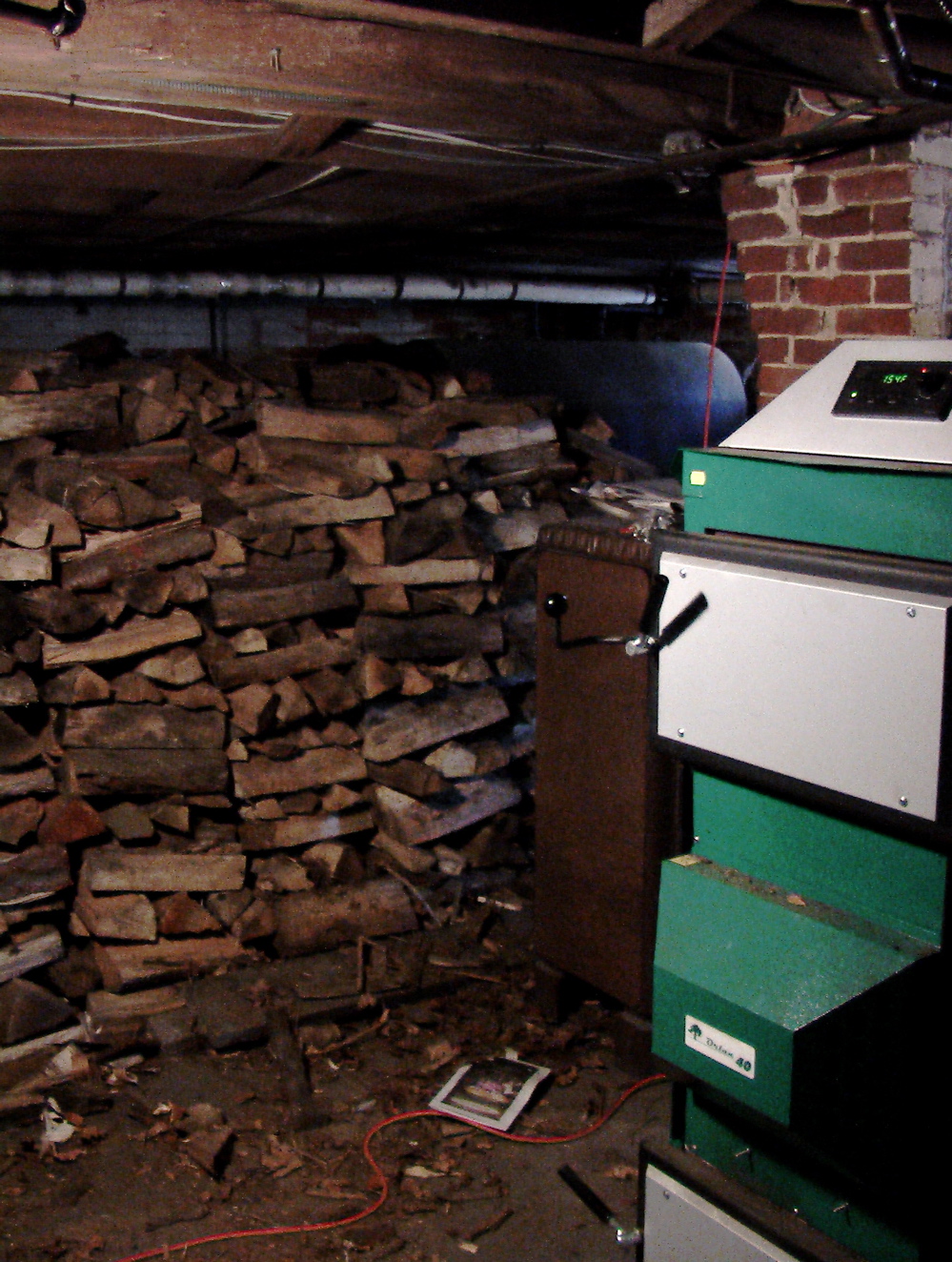
It was kinda crazy. In the end it took four of us, a tractor, a pallet jack, a bunch of thick planks, and a bottle of dish soap. The tractor inserted the boiler into the barn. We slid it on soapy planks across the dirt floor, wrangled it onto the pallet jack, and then wheeled it across the cement floor to its current home.
Finally, in early December, Bob did the hookup and we fired it up. It’s been running continuously ever since.
In photo 1 you can see glimpses of all four heating-system eras my 1870 home has known.
The chimney, one of three, originally vented several fireplaces.
The brown box sandwiched between the green-and-white EKO boiler and the woodpile is a coal burner which must have supplemented wood heat at one point.
Then came oil. You can see one of two 250-gallon tanks in the corner behind the woodpile.
And now the EKO boiler, a modern, electronically-controlled device that brings us full circle back to wood.


Photos 2 and 3 show how the EKO ties into the pre-existing hydronic system. In photo 2 you’re looking at five circuits. Right to left, corresponding to four circulator pumps, are three house zones and a water heater circuit. The leftmost fifth circuit runs through the EKO.
Backing away in photo 3, you can see the EKO on the left, and all five inputs to, and outputs from, the oil burner at bottom right. The EKO is hooked up in series. This costs me some efficiency because, although the oil burner rarely runs, its water jacket soaks up heat. But that may be healthy for it, and though mostly sidelined it’s still a crucial piece of the puzzle.
If the EKO’s water jacket drops below a set temperature — currently 140F — the fossil fuel furnace kicks in automatically. Among other things, that means we can go on vacation without worrying about frozen pipes.
Photo 4 shows parts of the control and safety systems. The green tag is hanging next to a pressure relief valve. If the boiler were to overheat, that valve would open and dump water out onto the floor.
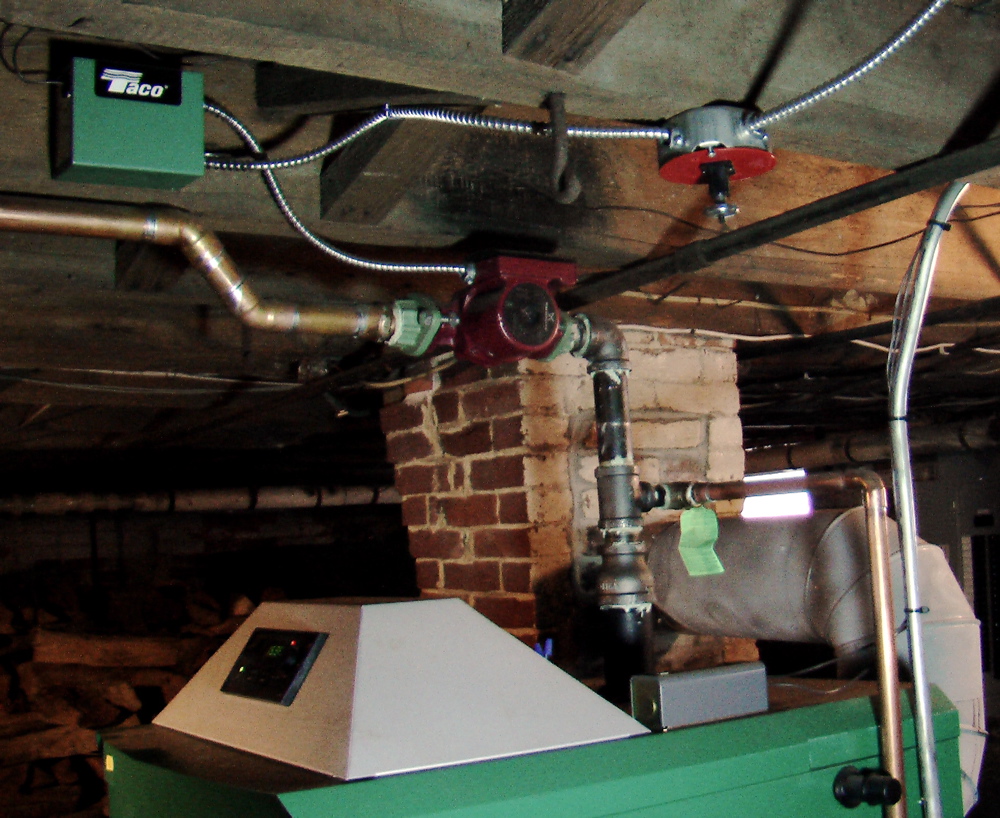
The red circulator pump appears near the center of the photo. The green box at top left activates the circulator when the boiler’s water jacket reaches a threshold currently set at 160F, and then keeps it on until the water temp drops below 140F, at which point the oil burner kicks back on. With the EKO running continuously, the EKO’s circulator can, and does, run for days, idling the oil burner completely.
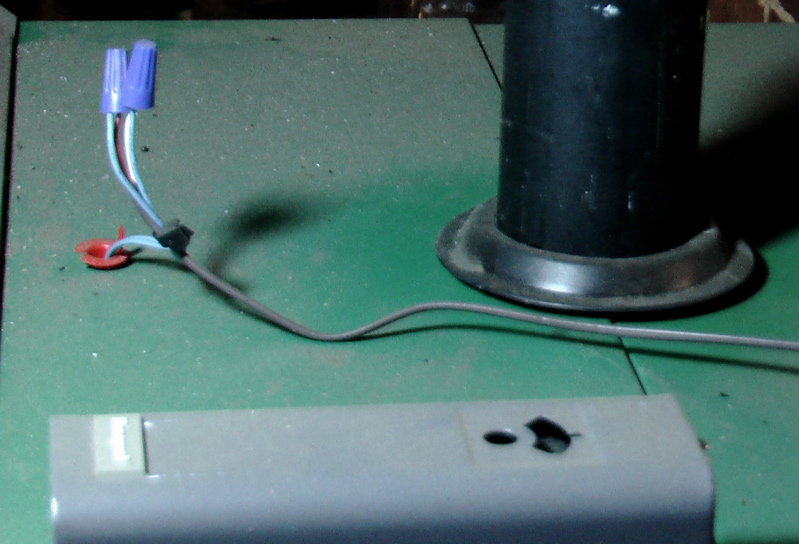
Photo 5 shows a sensor that’s been placed directly on the boiler’s water jacket through a hole drilled into the top cover. Its signal travels to the digital controller shown in photo 7, which actuates the pump switch in photo 4. It also controls a safety cutoff, shown at the bottom of photo 5, that would shut down the boiler (electrically) if its temperature went above 210F.
In photo 6 you see the EKO’s control panel. The dial controls the setpoint, which is currently set to 165F. Because the current temp in this photo is below that, the EKO is running in gasification mode. Once it reaches the setpoint, it drops back to idle mode.
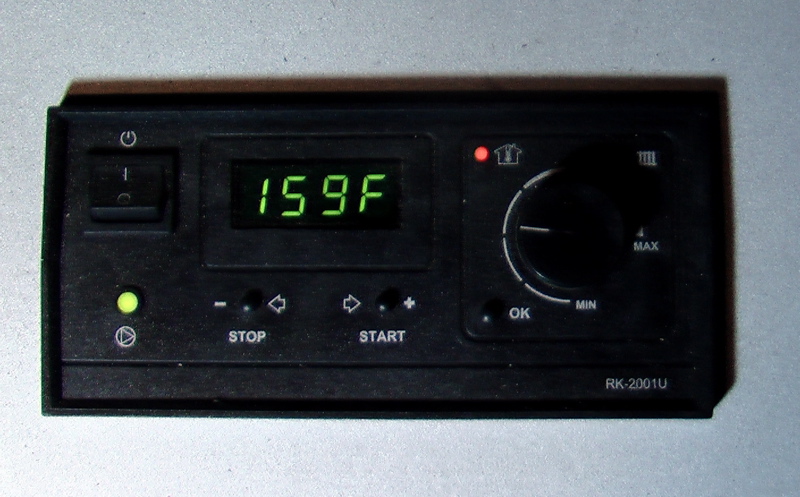
There are a bunch of menu options here, but so far I’ve only had to fiddle with the setpoint and the fan control. Gasification works by way of a downdraft that sucks wood gas from the firebox in the top chamber down into a bottom chamber where superheated combustion occurs. In idle mode the fan runs at 40% capacity. In gasification mode it can run from 50% to 100%. I’m currently running at 60% unless it’s really cold (10F or below), in which case I bump up to 70%.
This isn’t ideal. I throttle back to keep the boiler from running too hot. Even when idling, there’s a minimum amount of heat produced, and it has to go somewhere. In the ideal scenario, you run flat out in 100% gasification mode and charge up a big thermal battery — e.g., a 500-gallon insulated water tank — then draw on that stored heat. That would be the most efficient, cleanest-burning way to use the EKO.
But the current setup was already a financial and logistical challenge so, like a lot of folks, I’ve punted on the storage tank for now. Meanwhile, we’re thinking about extending a circuit to the attached barn where Luann has her studio, which is currently heated by propane. If we do that we’ll give the EKO more water to heat, it’ll work harder, and it’ll be happier.
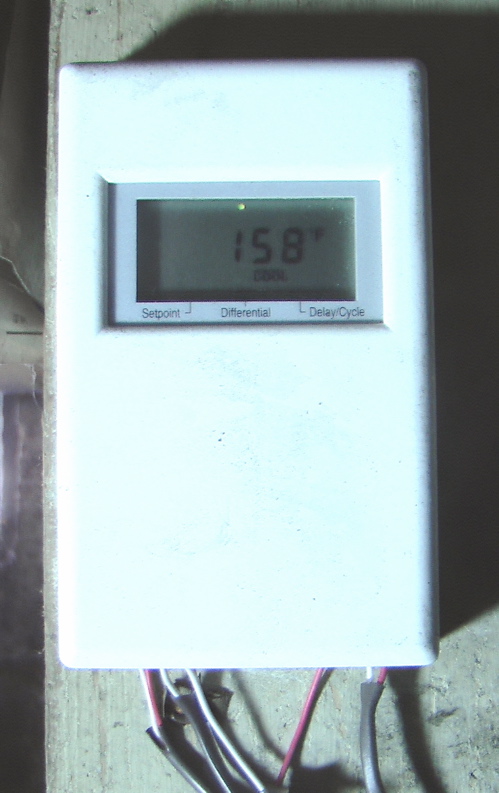
There’s one more safety feature related to overheating. In addition to the relief valve and the high-temp cutoff, the digital controller can activate one of the house zones (the biggest one) and dump excess heat there, even if the zone isn’t calling for it.
The controller appears in photo 7. It senses the EKO’s temperature, switches the EKO’s circulator pump, and controls its high-temp cutoff (see photos 4 and 5). It also controls the fossil fuel furnace, turning it on when the EKO’s water drops below 140F, and off when it rises above 160F.
damper open/close rod
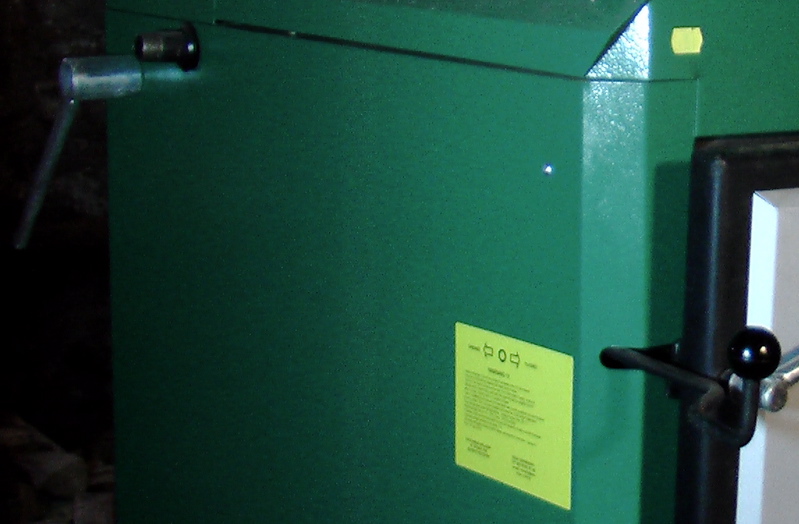
Photo 8 shows the only two manual controls. The lever at top left cleans the heat exchanger. You just give it a stir whenever you load wood.
The rod with the ball handle opens and shuts the damper. Here it’s pulled out, the damper is closed, and the boiler is running. To load fuel you push in the rod to open the damper, power down the fan, and open the firebox door. When you’re done you shut the door, pull out the rod again to close the damper, and power up the fan.
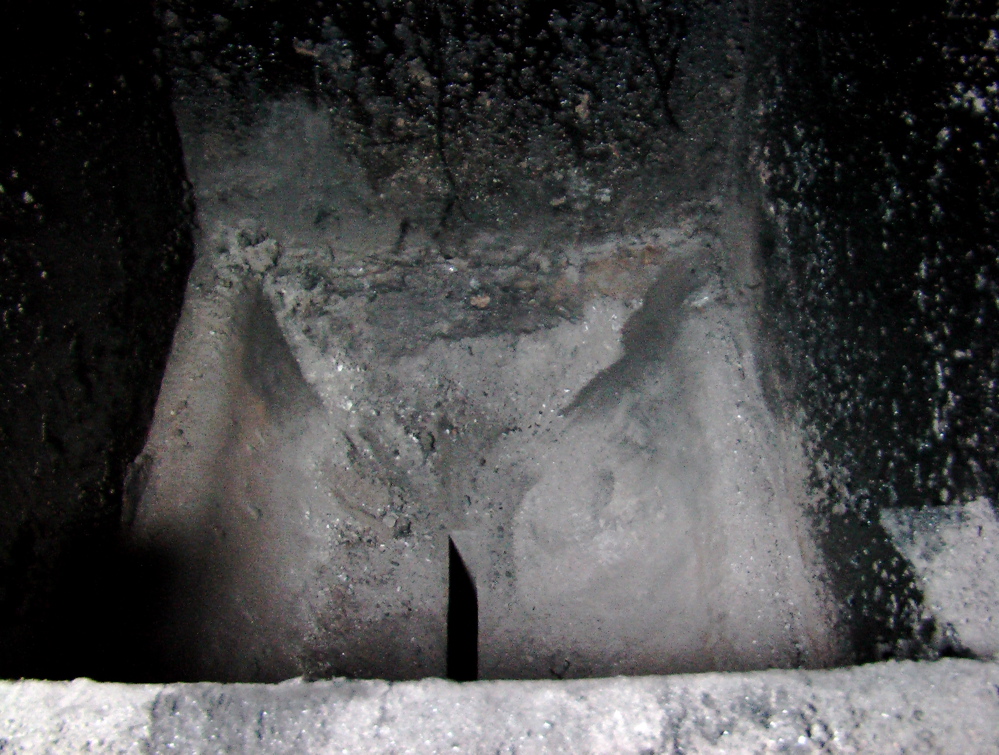
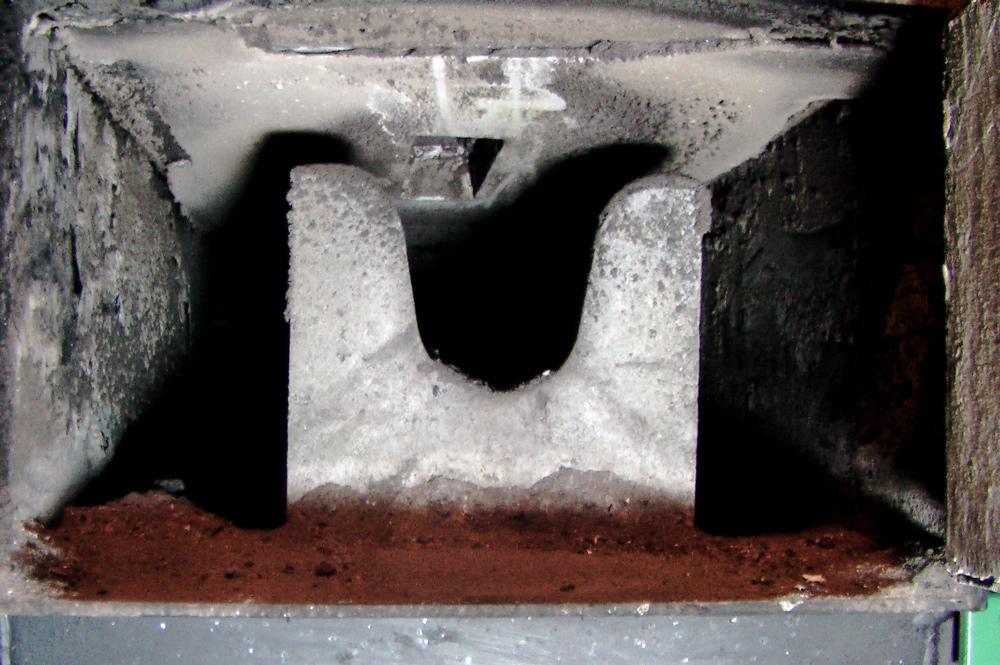
Photo 9 shows the firebox. It’s big, you can load four or even five good-size armloads of split wood. The slot in the bottom connects the top chamber, where the wood burns and emits gas, to the bottom chamber, where gasification occurs.
Photo 10 shows the gasification chamber. You can see the same connecting slot, here from the bottom. Remember, the wood fire burns in the top chamber. Some people like to say that wood gasifiers burn upside down. There isn’t a lot of heat in the top chamber, and the stack temperature runs below 300F. The real heat happens in the bottom chamber.
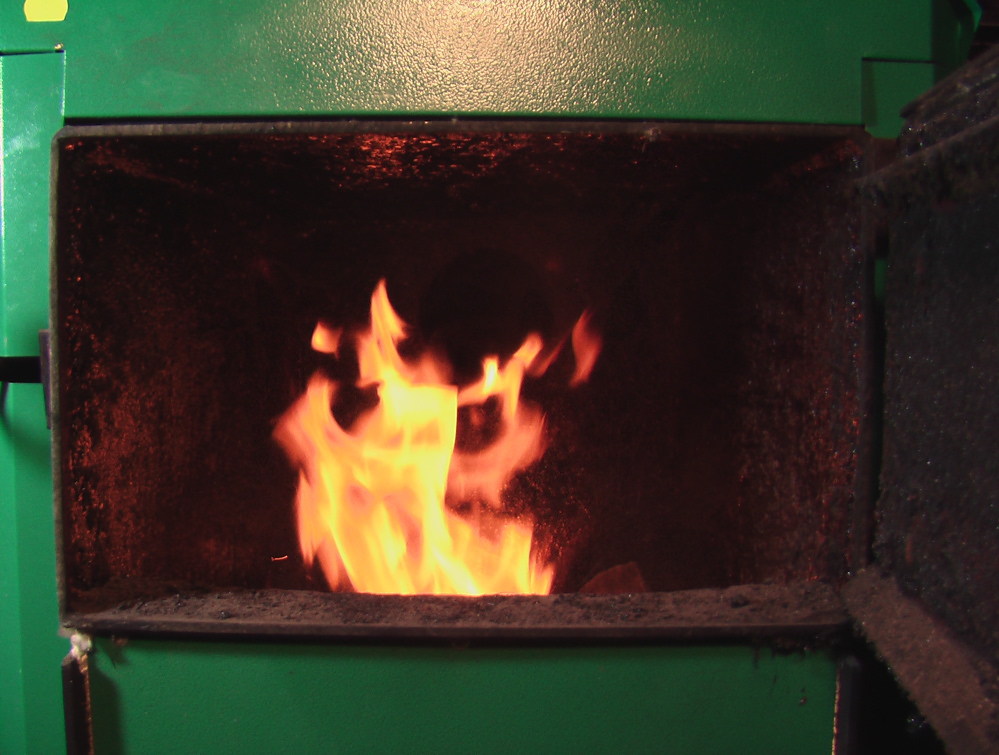
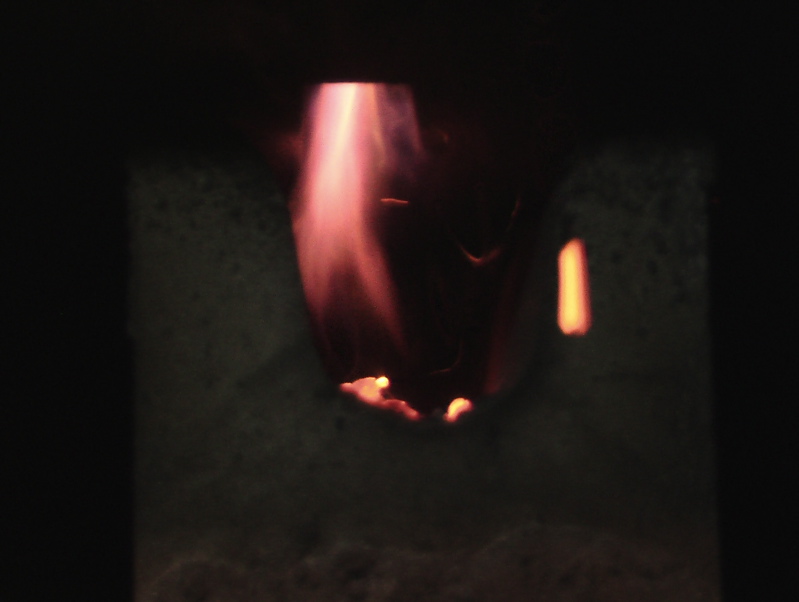
Photos 11 and 12 show the two chambers in action. In photo 11, I’ve lit a wood fire in the cold, freshly-cleaned boiler. You just use newspaper, kindling, and a match, as with any wood fire.
In photo 12, a few minutes later, I’ve loaded more wood into the top chamber, shut the damper, and powered up the fan. What you see, and hear, is like the exhaust from a small rocket engine. At full blast, the temperature approaches 2000F.
A couple of minutes after photo 12, the readouts in photos 6 and 7 hit 160F, the oil burner clicked off, the EKO’s circulator pump clicked on, and my wood-fired central heater was back in action.
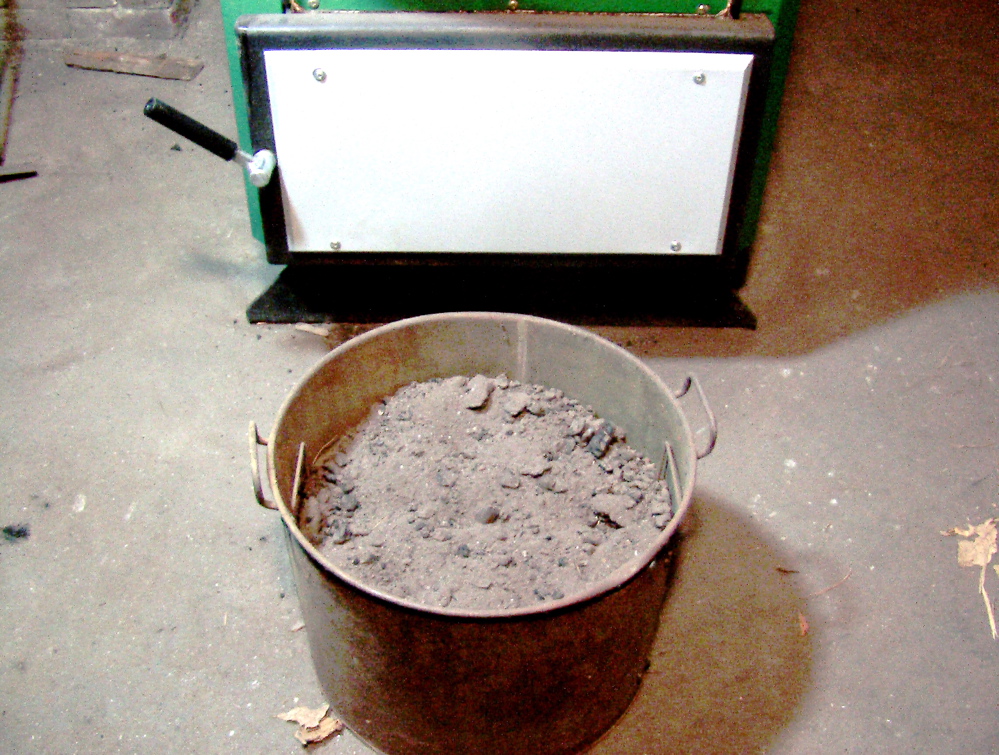
Today’s January 11, and it’s been running since Dec 4. There isn’t much maintenance. I should clean out the ash (and scrape out the creosote) weekly, but I’ve probably only done it three times since I started. Photo 13 shows the entire quantity of ash I’ve removed. As you can see, it isn’t much. The EKO has turned a lot of wood — I’m guessing close to two cords by now — into a very compact volume of powdery ash.
Two cords? I know. Although it does burn for a long time — a full load can go from eight to twelve hours, depending on the outside temperature — this thing eats wood for breakfast, lunch, and dinner. I bought six cords of semi-seasoned wood, it’s only January 11, I may need to supplement with some seasoned wood come March or April.
Still, I’m OK with that. It’s wonderful to sideline the oil furnace. I’m not saving as much as I would have at $140/barrel oil, but I’m still saving. And I feel like I’ve bought insurance against price volatility that was driving me nuts. Lots of friends pre-bought oil at four-fifty or even five bucks a gallon. That bet paid off every year except this one. I hated living with that craziness.
At May 2008 oil prices, I was looking at a three- or four-year payback for this solution. That doesn’t seem likely now, but I don’t regret the decision. The house is future-proofed with a flexible trio of heating systems. There’s the pellet stove which I still use in spring and fall, the wood boiler for winter, and the oil furnace for backup and for summertime water heat.
There’s been no help from the federal government, by the way. I did some research last fall to find out if my investment in this solution would qualify for a tax credit. According to energystar.gov, there is a tax credit for biomass stoves. But not for 2008. I’d have had to wait another month to earn 2009’s $300 credit. Oh well. EKO-Vimar probably doesn’t provide the manufacturer’s certification statement anyway.
To be honest, I’d rather be living in a smaller, newer house that doesn’t need a furnace. Maybe someday I’ll be able to gut and super-insulate this old house. But meanwhile, like nearly all New Englanders, I’ve got to burn something to survive winter. Most of us still burn oil. But some of us are going back to the future. It’s 1870 again with a twist. We’re burning renewable biomass in clean, efficient, smart appliances, and pumping dollars into the local economy. It’s a start.

Wow…great story, Jon. I’ve heard bits and pieces in the blog and podcasts over the past year, but this really brings it together. I don’t think I’ll ever need this particular solution in Georgia *grin*, but you should that there are ideas out there to be tried, that persistence can make things happen, and sustainability doesn’t have to mean deprivation. Bravo!
The impressively small quantity of ash speaks for the high efficiency of your system, Jon. (The two stoves that supply the only heat in our house–one an efficient kitchen cookstove, the other an EPA-certified Napoleon 1400–produce that much in a week.)
Do you get all your household hot water from the EKO-40? If so, that’s quite a savings.
But what about power outages? Don’t all three heating systems have electronic components?
> sustainability doesn’t have to mean
> deprivation.
Now that I personally heave every log, though, it does, make me acutely conscious of the amount of energy — of one sort or another — I have to pump into this structure.
I would love to see a WPA-style effort dedicated to major home retrofits in the northern US climes.
Think what could be done with a fraction of the money we’ve given to the banks to do…what exactly?
> Do you get all your household hot water
> from the EKO-40?
We do. We’d already switched hot water from electricity to oil some years back.
> But what about power outages? Don’t
> all three heating systems have
> electronic components?
Exactly right. I should’ve mentioned that. It’s a pretty significant vulnerability, especially in light of the epic outage that took out the majority of NH homes in December. A lot of folks bought generators in the wake of that episode. I haven’t yet but probably should.
I commend you for trying and succeeding in the face of the permit bureaucracy.
I would be interested in a rigorous analysis of the investment and savings (perhaps just with the actual experience of oil prices rather than theoretical oil prices). I have personally installed and compared direct solar applications for many years for my personal use and the payoff is over very long time periods. This is despite reducing the monthly costs in half for heating.
The dependence of these systems on electricity is troubling. Only direct solar can avoid that with convection but NH is a little far north for that to be useful.
There are two notions I find intriguing.
If you want to build a cost-comparable and conventional-looking passive solar house, then the “solar slab” design from James Kachadorian is brilliant. His Green Mountain Homes started building passive solar houses (in New England!) in the 1970’s. He also wrote a book on how to use the design.
If you are less concerned with convention, the use of high thermal mass walls (rammed earth or similar) in the design of a house is also interesting.
I completely agree that both passive solar and high thermal mass are building strategies that would work incredibly well for New Englanders. Even if the packed earth walls are more of a windbreak around the exposed walls of the house, heat savings could be dramatic. Earthships in New Mexico are a great example of these techniques.
I agree with previous comments made about the ash output. In Virginia we heated the house with nothing more than a single cast iron woodstove in an old 1890s era farm house. There was no ductwork or radiators, just a giant open stair well that all the bedrooms opened onto. We had electric baseboard as a back up in each bedroom. The minimum amount of wood we used for any given winter was 3 1/2 cords, but we always estimated 4 for a measure of safety. And sometimes we would cut the wood ourselves or split the logs ourselves with a borrowed log splitter. Boy that takes me back.
Thanks, Jon. I’ve been wondering how the gasifier worked out. We almost bit on a pellet boiler last fall, but balked at the price. Instead, we knocked out most of the first floor wall bisecting our cape, which improved the circulation so much that the pellet stove in the living room is keeping most of the house mostly warm most days and nights.
> Instead, we knocked out most of the
> first floor wall bisecting our cape
That’s a good strategy. Thought about that here too but the house is just too compartmentalized.
Thanks for all the helpful info, Jon. I ordered a pellet “furnace” for the basement which never showed up…and wondering what to do for next winter. I’m considering a second woodstove as an option…wondering why you didn’t go with a pellet furnace…was it only because you wanted to diversify your fuels?
> was it only because you wanted to
> diversify your fuels?
Yep, that was the main reason.
Nice story. Fugacity works. Wood gasification, fugacity. Oil has fugacity traits as well. Heated with water anaerobically it can be gassified as well. Oil gassification is also magnitudes more efficent then just oil. Any ideas about a possible oil gassification unit for heating?
Great project! Thanks for sharing and the write up. How did the insurance aspect pan out?
> How did the insurance aspect pan out?
Smoothly, once I assured them that the city was on board, and that licensed installers would be doing all the work.
Hi Jon
I’m admiring of the way that what you have done illustrates some of the directions that governments should be taking. Thinking ‘local’, using a fuel that’s to-hand, high quality technology, an energy solution that ‘remembers’ that the market is a poor judge of what’s good for people and the planet, and breaks dependence upon agencies that use the market to decide what’s good for us.
Jim
Hello,
I just listened to one of your podcasts about heating with alternative sources in New England and you discussed wood and solar. I wish you would’ve talked about geothermal as an alternative, too.
Geothermal systems are extremely efficient, provide heat, air conditioning, preheat for hot water and hopefully reduce the CO* output.
We invested in a geothermal system two years ago in Bedford, New Hampshire. Our electric bills that cover water (we are on a well), all electrical appliances, hot water and heat are between $200 and $250 in the winter. So we are saving even with the low oil prices ;)
-lajos
Interesting (heat and power) dual use system:
In September 2008 Pritchard Power Systems, with assistance from the Federal Government’s COMET program, completed and demonstrated a small steam engine fueled with wood pellets, the S5000, designed to produce around 5kWp of electricity.
Pritchard Power Systems – home:
http://bit.ly/eK2J
Pritchard Power Systems – Technology:
http://bit.ly/xHW0
Videos: http://bit.ly/2XxUiN
The Pritchard Power Systems S5000 is a small scale, multi-utility, enterprise energy system, capable of delivering mechanical power and electricity, hot water, space heating and if required, steam, all from the lowest grade fuels. The S5000 is designed to produce around 5kWp of electricity, and is shown in a test run.
> I wish you would’ve talked about geothermal
> as an alternative, too.
Me too. So far I haven’t had any personal experience with geothermal, or met an appropriately knowledgeable expert, but maybe you can help me find one!
Dear sir
I need some information ebout big wood coal machinery to purchase
Very intressting too read abuot your meating with gasification boiler
Thanks for a most interesting article. We live in a large house in SW France. The recent hurricane here has left us with approx 60m3 (17 cords) of oak logs so we are considering an EKO-40 (with storage tank). (Currently the house is oil heated). Your wood burn rate is quite high. Do you have any idea what it would be with a storage tank?
> Your wood burn rate is quite high.
Yes.
> Do you have any idea what it would be with
> a storage tank?
No, and I’m very curious about that.
The burn rate could be down to the type of wood,or just need a little tweek
Forgot to thank you for an excellently written article
I have just purchased a wood gasification boiler that I will put in a shed about 150 feet from the house – piping the heat to a 100,000 BTU copper tube heat exchanger in a 900 gallon thermal storage tank. I have an oil furnace currently with about 6 zones to the baseboard in my old farm house in Maine. I am wondering about how to design the system. I have heard that it is better to hook the twp systems up so the wood boiler heat does not run through the oil boiler. This is much more work and more complicated and wonder if there really is much heat loss in going through the existing boiler. Do you have any sense of just how much loss there is?
Jim,
Did you ever in install this? I’m thinking of doing the same exact thing. Did you use pressurized storage?
> Do you have any sense of just how much
> loss there is?
I do not. However Bob Jennings (http://blog.jonudell.net/2009/01/19/a-conversation-with-bob-jennings-about-new-ways-to-heat-with-wood/) did suggest that there is another benefit to keeping the oil furnace warm: It’ll stay healthier that way.
What is happening with the wood tar and spend fuel?
Great article, just about finished with my install of the EKO 60. It seems that wood gets such a bad rap. But the truth is, wood is cheaper per BTU than any other heat source out there. Our install was a nightmare as well. After reading about the gasifiers, I decided on the EKO and found a few guys in the area who could do it for what seemed a reasonable amount. Well, it was headache after headache. Codes, prevented me from doing the Powervent option, plus I heard that option isn’t ideal, so we ended up building a chimney, but that was after we got the EKO delivered. Then, getting the 2000 pound beast in the basement was a chore in and of itself as originally we were going to put it in a shed outside. Code prevented us from doing that since it needed a vertical dump zone. We had the thing put in a shed though before we found out about the code violation. Most states allow this, but Maine needs the vertical dump zone to protect the shed apparently. :) You would think states with lots of trees and few people would be on board with wood heating devices and make it easier. Oh well. We had trouble finding an installer who wouldn’t rip us off with the install and who would do it the way we wanted. Most were scared to death of the beast. The problem was we needed an installer with a wood burning license, somewhat common, but limiting, then on top of that, how many of those have experience installing something like this. We eventually convinced one of the installers, who was scared to take the project on, into doing it. I think he did a great job, but it was a learning process for both of us. We did go with two 500 gallon propane tanks for storage. You would definately find your wood consumption dropping with the use of storage due to the fact that these beasts like to burn flat out, and if the thing is idling all the time because your zones are satisfied, then heat is just going up your chimney, not to mention a lot of creosote. I am hoping for one load a day during the coldest days, because my wife won’t touch the thing, that was our agreement. We are keeping our oil boiler as a backup, so they are tied in series. I figure either tonight or tomorrow night will be the first burn, as I am almost done insulating the tanks. It is about 80 degrees and can’t imagine how hot the house would get without the insulation.
I wish people like us were more common. These gasifiers are falling by the wayside as more “green” sources such as geothermal and solar get a lot of attention. Solar is great if you have radiant floor heat since you are able to use the lower temps, but most in NE do not have that. Geothermal, still uses a lot of electricity, so it isn’t necessarily green, plus it is only useful for forced hot air, so you would need to change to ductwork throughout your house. Granted, you get AC in the summertime, but here in Maine, I can count the AC usable days on my fingers and toes. Plus I grew up with forced hot air and didn’t like it as heat was not constant and changed with room location. With forced hot air you would generally have only one zone, which lets face it is not ideal.
Once again loved the article. I feel your pain, and love your perserverance.
> the Powervent option
What’s that?
> Code prevented us from doing that since
> it needed a vertical dump zone.
What’s that?
> We did go with two 500 gallon propane
> tanks for storage.
Nice. Wish I had but it was dicey enough just getting the basic system in. Hope we can add storage in the future.
> These gasifiers are falling by the
> wayside as more “green” sources such as
> geothermal and solar get a lot of
> attention.
Interestingly there /is/ an incentive here in Keene, although nobody knows about it, and I was the first to claim it:
http://blog.jonudell.net/2009/04/23/a-different-take-on-green-keene/
In Maine and many other states you can’t vent oil and solid fuels out the same chimney. A Powervent can be used for the oil boiler, but it has to be so many feet from a window, so many feet above ground, and can stink if you have a window open anywhere near it.
Basically the vertical dump zone, also to Maine code requires the boiler to be hooked up to a zone that is above the boiler so that if it overheats, some of the heat will be distributed to the zone, thus hopefully cooling the boiler down. So if we had it in a shed, we would need a pipe coming up through the roof of the shed into the side of the house. :) That idea got squashed pretty quick. The vertical dump zone really just protects the boiler, but there are many safety features on these that make the dump zone seem unnecesary. Now, with the boiler in the house am I glad I have the dump zone, yes definately. But in a shed?
On the tanks, they are older propane tanks that could still hold propane and high pressures, but were instead taken out of service and had fittings welded to them. They are not ASME certified, so they aren’t to code, but they are able to hande pressures to over 1000 pounds and will generally be working with pressures of around 15 to 20 pounds. At worst, 30 pounds until the pressure relief valves kick in. We have relief valves on the EKO, one on the tanks hooked up to both of them, one on the oil boiler and one on the superstorage for the domestic hot water, so I feel very safe. We have ball valves on the tanks to be able to shut them off from the system, with collars I can take off so if a code officer came by, technically they wouldn’t be connected. I am really hoping the storage makes life easier. We went with the propane tanks instead of the open tanks for a lot of reasons, the liners on the open tanks degrade over time, there is a lot of copper coil needed for the open tanks = $ and possible leaks, we wouldn’t be able to keep the tank to the higher temp that we can with the propane tanks, and it is extremely simple, no exchanger necessary, plus they were at least $2000 cheaper even considering the huge expansion tank needed and the rigging company required to get them in the basement and the shipping charges from NY. So it was a no brainer.
Well, thats just it, nobody knows about these things, not even many of the installers. They are familiar with wood boilers, just not gasifiers. Its quite sad. My father-in-law who burned most of his life will argue with me about wood having gas that can burn. People don’t understand and associate wood burning with a campfire or wood stove.
We will qualify for the government tax rebate of I think $1500 for boilers installed in 2009. It meets the defintion so we will go for it. These incentives are nothing compared to the rebates on the geothermals and such. The problem this posed is that we are first to market and you experienced what I experienced because of it. These things are safer than a wood stove yet they are harder to get installed in regards to codes??????? Like Bill Clinton “I feel your pain.”
Hi Andrew,
I also live in Maine. Am very interested in your system. Since you wrote this all about a year ago and before actual use I was wondering if you would update as to “real life” use and performance. Please email or call me.
207 607-2669.
Thanks.
Gregory
That is a great article. I really think that money would have been better spent on something like geothermal.
Hi Jon
Great Article.
I am in the process of deciding on a heating solution for a house I am building in the country. I’m in Canada, Ontario and winters can get quite cold over here. Since the house is in a rural area, with no connections to anything other then electricity and a phone line, the options for heating are not that great, and once you do decide on something, the installation and provision of fuel to the system could be very costly too. Currently I have a cabin heated by a wood stove and it surpasses all my expectations. In the new house, a gasifier would be an idea solution in my opinion, I just hope the building inspectors in the area have heard of such a thing, and the lack of air ducts, oh, a dream come true!
Great work! Congrats!
I have had a EKO 40 in my home for 2 heating seasons.
A thermal storage tank is what I would like to install next.
I have had a EKO 40 in my home for 2 heating seasons.
A thermal storage tank is what I would like to install next.
Where can I get info on parts (gaskets) and old propane tanks dimensios?
Nice.
Sorry for my english.
Some facts:
1.wood gasification boiler must be conected to water storage tank(insulated min 50l on kw of power or more)
2.water return must be higher than 65 degres(celzius), use (laddomat,esbe,etc,..)
3.use dry wood(less than 20% humidity)
I have a Royal indoor boiler and want to upgrade to a gasifier.Eko 120000 BTU. I like the propane tank heat storage idea, Where could i find such a tank?
Gerald
My husband and I currently use a woodstove to preheat water for a propane-fired radiant heat system. We are thinking of our next step up the sustainability ladder, and a wood gasification boiler could be it, especially since we live in a woodlot. This is a great article!
When you say “cord”, do you mean a standard cord (4’x4’x8″) or a face cord (4’x8’x16″, or thereabouts)?
Yes, standard cords. I had 8 on hand last winter but it was mild and I only used 6.
Hi Mate I live in Australia and have been researching wood fired boilers for some time your site has been the most helpful to date one question .Could you bury the holding tank 500 gal and would the ground be good enough insulation
Thanks Mate great story
Could you bury the holding tank 500 gal and would the ground be good enough insulation?
Dunno. I’ve never heard of that being done but it’s an interesting idea!
NO !!!!! Don’t bury the tank unless you can insulate it and keep moister away because the heat will trans fer into the ground and you’ll burn all kinds of wood then. to learn more about wood gasification wood boilers and great discussion boards go to hearth.com
Hi Greg, I live in Northern Tasmania and have installed a Kuenzel wood-gasifying boiler system from Germany. There is a bit more information as a case study on my web site. It was not a cheap option, but we chose it as it enables us to use the wood grown on our property as conveniently and efficiently as possible.
Sorry Greg: web site is http://www.hamiltonenergy.com.au The Kuenzel system has 3,000 litres of very well insulated heat storage in two tanks, and a domestic hot water tank which can be heated indirectly by the stored hot water and by solar hot water collectors.
Just wondering if you thought of a heat storage system? To store the hot water
and thus using less wood.
It sounds like you went through a lot of wood, but you also mentioned that you live in an old farmhouse. A wood gasification boiler is something I’ve looked into for a new house that would be very well insulated. I’m trying to wrap my head around your results. Any reason NOT to think that wood usage would be much less with a well insulated house & a storage tank?
@Mike Just wondering if you thought of a heat storage system?
Yeah, wish I could’ve, wasn’t in the budget, maybe someday.
@Jason A wood gasification boiler is something I’ve looked into for a new house that would be very well insulated.
I think you’d be in good shape without the storage tank, and great shape with it.
I just fired up my EKO 40 for the first time. I’m the first in my city (and probably county) to have a gasification boiler. I live in Ithaca, NY. I own a duplex in downtown and I’m heating both my side and my tenant’s. I sprung for the 500 gal. storage tank, too.
I laughed when I read about your 6 month struggle getting it installed. Mine took 6 months as well.
Jon,
Just curious how everything is working out now after 2 years with the EKO?
I’m in Northern Vermont and considering a gasification unit to install and recommend.
I am also a heating technician, specializing in automating multi-fuel systems.
Thank you for your insight.
Matt
@Rudy, 6 months for you too? Because of regulatory red tape or actual logistics or both? Anyway, congrats!
@Matt, it’s going well thanks. I do wish I’d been able to add hot water storage to the system, and hope to someday, but in the middle of our third winter with it I’m really happy with what we’ve got.
Really a nice story regarding to Central heating with a wood gasification boiler. I like it also.
How does comment spam work? Is this to drive traffic to the URL behind “Plumber in Leeds”? Or part of some sucky SEO crap to raise the page rank of the URL?
Yeah. It’s interesting how the filters still can’t catch a lot of what is so obvious to a person.
[…] pumpA Comparison Of Different Types Of Central Heating BoilersHot Water Boilers and Heated FloorsCentral heating with a wood gasification boilerBoilers in […]
I’ve been heating a 2500 square foot residence with a Garn for 3 seasons. The gassification is most efficient with the maximum fast burn rate induced with a blower making the secondary chamber 2000 degrees F. I think of this system as a water furnace since it can store 700,000 Btu’s between 200 degrees and 140 degrees. The 32 lineal feet of 4 inch exhaust wind through the 1400 gallons of water and this flu needs brushing 2 times per season by simply turning on the blower to take away the loosened soot. My stack is horizontal discharging within 4 feet of the ground and shows slight discoloration of approximately a 3 foot circle on the snow. The combustion is clean and what does come out is mostly water vapor a natural product of burning. As with any energy storage is the real dilemma. A reservoir of a couple thousand gallons of highly insulated water is a simple method to store a million Btu’s. Glauber’s salt will store a lot too and at the useable phase change temperature of 95 degrees F. but there are some complications water doesn’t have. If storage is really considered and I don’t mean a piddly 500 gallons then the many issues of a slow smoldering appliance can be avoided.
[…] More here: Central heating with a wood gasification boiler […]
hi everybody
great article, and i am curious about few details, if Jon Udell can clarify please. its about how much wood cords he used.
how big is the house you are heating? how good insulation it has? how many rooms you are heating w this system?
how long heating season lasts in your area? what kind of outside temperatures you got there?
best regards
Very nice pictures of wood boilers and controls. It’s not a popular topic on the internet its hard to find arcticles or even pictures on the subject.
Good Story. Its a start, a good start! :)
Interesting artical from a few years back. Good on you for getting one of these up and running.
I am busy installing these Polish Eko Vimars in the UK, it now takes 4-5 days to install each one.
We usually specify ;-
50 to 70litres of water storage tank/kw of boiler output, the 40kW (132K BTU) I just put in had a 2400 ltr (633 US GAL) tank .
A manually switch chimney fan for refuelling and start up, stops you filling the room with smoke when refueling.
A condensate drain at the bottom of the flue as in slumber mode they can condense in the flue.
You can not run a short flue/chimney, it has to be 4.5m lto 5m long minimum as the boiler need a high chimney draft.
Use twin wall insulated INOX stainless steel with silicon seals as it can be a condensing pressuried chimney.
A pumped return, not the flow as we pump to an accumulator we don’t want to ruin stratification, plus the pump really has to be a laddomat type set up.
Withe Ladommat 21-60, we use a 80 to 90 degree centigrade flow temp and the return water is blended to 72 degrees using a laddomat pump and regulator. Gasification boilers run best at hot flow temperatures, the wood in the chamber needs to stay hot to gas off. The laddomat is essential as it has a ‘power cut’ drop out, so the boiler will work on gravity if the power fails.
Generally these boilers are run closed not open vented. With the large accumulator tanks this means big expansion vessels, 200 to 800 ltrs, 10% by volume. Also 1% corrosion inhibitor by volume is very expensiive,, so make sure you can completely isolate the accumulator tank from the system..
The safety coil should be connected via a 97degree safety valve to the house water supply. The safety discharge outlets need to be taken to a safe place to dischard potentailly scalding water. A nearby drain would be the best option.
We often just piggy back into the existing heating system and leave the fossil fuel boiler in situ. No expensive low loss headers with loads of pumps, just a simple 2 port valve, one pump, a non return flap valve and single pole changeover switch to switch between oil or wood.
In the summer the wood boiler can be batch fired once every few days to charge the accumulator with heat so hot water can be delivered.
We also use an electric thermomatic K head on the 3 way blender at the output of the accumulator tank. This regulates the flow temp to around 70 to 75 degrees, or can be weather compensated to vary with outdoor temp if required. The 3 way blender also minimises the effect of the heating return water from mixing up the stratification of the accumulator.
I got three projects to do at the moment, two 18kW’s + 1000ltrs, and one 60kW+4000 ltr tank. .
This excellent website certainly has all of the info I wanted concerning this subject and didn’t know who to ask.
looks well jon i have purchased the eko 40 this year i would like to know how far out the back of the boiler does your flue pipe go before it goes vertical
Oh my goodness! Incredible article dude! Many thanks, However I am encountering troubles with your RSS. I don’t know why I am unable to join it. Is there anyone else getting the same RSS issues? Anyone that knows the answer can you kindly respond? Thanks!!
Thanks for your article . It’s been over four years since you wrote it. How is the EKO doing now? Have there been any maintenance issues?
I have been looking at the EKO brand for two years and others I like it the best and would like to hear from you how it is working now. I converted my system that utilized common water to a system that has separate systems of water to now just utilizing the hydronic system with a heat exchanger in a large 1500 gallon insulated storage tank. I removed the oil boiler! I run the stove periodically to heat the tank the next step is to either build or buy a gasification boiler. I have dramatically reduced wood consumption. I am currently running it every three days for about six hours. The EKO brand claims 90 plus efficiency would you agree with that?
It’s working well. Things were getting smoky last season but I replaced the gasket on the top door and it’s fine now. I still have not gotten hot water storage going, but I would love to experience the reduced wood consumption and cleaner burns that would yield.
Jon, thanks for all of this information. I didn’t see if you listed the costs in all of this. Can you let me know how much everything was, as I am in the market for a gasification switch over. Best, Joe Cohen
Yep, I’m looking for the same information that Joe mentioned here. Was hoping you can provide a ballpark figure or something about the expenses.
A detailed information about wood gasification boilers with images descripting its working. Loads of appreciation to the writer for posting such an informative content.
Thanks for this article. I am considering getting an Orlan gasification boiler, but my friend. who fits wood burners, thinks something like a water heating Dunsley stove would be better as that would be inside the living room, rather than in the boiler room and he thinks quite a lot of heat would escape from the Orlan into the boiler room and be wasted, while with a water heating stove any heat not going into the water would heat the living room. How hot does the outside of the boiler get? (The water heating stove would be no good for summer though, as only about 55% of the heat it produces goes into the water. Also it claims slightly lower overall efficiency – 81%, compared to 91% for the Orlan)
Andrew
“he thinks quite a lot of heat would escape from the Orlan into the boiler room and be wasted”
The Orlan is quite well insulated. And in my case, it was in the basement so I didn’t mind have some rejected heat warming the basement and flowing up into the house.
Superb Blog!!! Thank you for sharing useful and valuable information. In this blog you share all the important things about central heating with wood gasification boiler. I really appreciate your Research and Efforts.Have A Nice Day!!!
There have been a vast number of designs of steam boiler,particularly towards the end of the 19th century when the technology was evolving rapidly.
http://www.cn-eastpower.com
Hi, did you finally install a water accumulator? We are using an Effecta Lambda 25 kW wood boiler (we only use logs, no pellets) to heat our house in the Basque Country in Spain + solar water heater (not too much sun in the winter, though) + wood-fired kitchen by Lacunza (a local maker from Navarra). The house is off-grid too, powered by solar entirely. We have two insulated accumulator tanks: one 1,000 liter one for radiator heating, and one 500 liter one for sanitary (kitchen and bathroom) water. Everything is working quite well (it’s our first winter in the house), though we do burn a lot of wood (you’re right) and also a lot more ash than you do in the Effecta boiler. I wish the design of the boiler made it easier to clean. We like to scrape the creosote and ash left in the gasification chamber every morning. It also has an internal cleaning system that cleans the heat exchanger every time you open and close the loading door. But the ash collector at the bottom is too small for the amount of ash that falls in and most of it falls on the floor of the compartment.
“Hi, did you finally install a water accumulator?”
We sold the house in 2014, dunno if the new owner has done that.
“I wish the design of the boiler made it easier to clean.”
Yeah, that wasn’t fun. I figured there would be less creosote with a storage tank because you could then burn fast and hot without throttling back. But never got to test that theory.