January 2009
Monthly Archive
January 28, 2009
Posted by Jon Udell under
Uncategorized [8] Comments
Some people say that cloud services are just web services rebranded. Since I’ve always defined web services inclusively, I tend to agree. But I do think that the emerging notion of cloud computing leads us toward greater abstraction of resources. And as I build out the Azure service described in this series, one of the resources I’m abstracting more than ever is the file system.
I’ve built online services for many years, and have always been aggressive about logging everything they do. Detailed logs assure me that things are working well, or help me figure out why they’re not.
My services have always done logging in the grand Unix tradition: They append lines of text to log files. I probe those files using tools like tail (to peek at the end) and grep (to search).
You can’t do things that way in the Azure cloud. True, the default logging mechanism writes to blobs, which are the moral equivalent of named files containing arbitrary streams of bytes. But your service can’t just open the log and append to it. Instead it calls a method, RoleManager.WriteToLog, that sends a message to the log. And in order to peek at the most recent entries, or search the log, you have to download one or more quarter-hourly blobs, then parse the XML records inside them.
So instead I’m using a cloud database. Or actually, three of them. One is Amazon’s SimpleDB, the second is the SQL Server-based SQL Data Services, and the third is Azure’s table storage. I figure my service will generate a lot of real data over the long haul, and it’ll be interesting to compare these services as they evolve and grow — and as the types and quantities of data I’m logging grow along with them.
In all three cases my pattern is the same. For each service, I’m wrapping a thin C# library around the HTTP/REST interface. The existing wrappers I’ve found, for Azure and SQL Data Services in particular, tend to hide the HTTP/REST interfaces. But I want to be able to see and touch them.
When I’m developing software that relies on a web-based infrastructure service, I want to be able to access that service in as many ways as I can. When I get stuck I can drop down to the HTTP level, and there I can triangulate on a problem in many complementary ways: from the command line using curl, from Python, from C#, from an HTTP sniffer.
Another pattern common to all three logging mechanisms is mixed use of statically- and dynamically-typed languages. Although I’ve written these interface libraries in C# in order to deploy on Azure, I use them from both C# and Python. When my Azure-based service logs its activities, it invokes the structured-storage interfaces from C#. But I invoke the same interfaces from IronPython to view, query, and analyze the logs. And if IronPython becomes a service provider on the Azure platform, as I hope it will, I’ll invoke the same interfaces again to write, as well as read, the logs created by those services.
So, for example, the current version of my SQL Data Services interface library is here. (Corresponding tests here.)
This is the method that writes a log message:
public static void sds_write_log_message(string type, string message,
string data)
{
var dt = Utils.XsdDateTimeFromDateTime(DateTime.Now);
sds_flex_entity[] entities =
{
new sds_flex_entity("type","string",type),
new sds_flex_entity("message","string",message),
new sds_flex_entity("datetime","dateTime",dt),
new sds_flex_entity("data","string", data != null ? data : "")
};
string id = "id_" + System.DateTime.Now.Ticks.ToString();
var sr = create_entity("elmcity","events", "Event", id, entities);
And here’s create_entity which invokes the REST API:
public static sds_response create_entity(string authority,
string container, string entityname, string entityid,
sds_flex_entity[] entities)
{
byte[] payload = make_sds_entity_payload(entityname, entityid,
entities);
var response = DoSdsRequest(authority, container, null, "POST",
payload);
return get_sds_response(response, false, entityname, null, null);
}
The container for this set of records is called events, and it lives in an authority called elmcity, so the request URI will be https://elmcity.data.database.windows.net/v1/events, and the body of the HTTP POST request will look like this:
<s:Event xmlns:s='http://schemas.microsoft.com/sitka/2008/03/'>
<s:Id>id_012345</s:Id>
<type xsi:type='x:string'>exception</type>
<message xsi:type='x:string'>DoHttpRequest: ProtocolError</message>
<datetime xsi:type='x:dateTime'>2009-01-29:T12:42:01</datetime>
<data xsi:type='x:string'>400 Bad Request</data>
</s:Event>
Here’s the method that queries a container and returns a package of results:
public static sds_response query_entities(string authority,
string container,
bool in_ns, string entity, List<string> entitynames, string query)
{
var response = DoSdsRequest(authority, container, query);
return get_sds_response(response, in_ns, entity, entitynames, null);
}
In the current version of the SQL Data Services query syntax, here’s how you ask for recent log entries:
from e in entities
where e["datetime"] >= "2009-01-29:T14:00:00"
orderby e["datetime"] ascending
select e
Here’s the method to transmit that query to SQL Data Services:
public static sds_response query_entities(string authority,
string container, bool in_ns, string entity,
List<string> entitynames,
string query)
{
var response = DoSdsRequest(authority, container, query);
return get_sds_response(response, in_ns, entity, entitynames, null);
}
The HTTP request again goes to https://elmcity.data.database.windows.net/v1/events, but this time it’s a GET not a POST, and the full URI ends with “?q=” plus the “from e in entities…” query from above.
The HTTP response is a sequence of XML packets like the <Event>...</Event> example shown above, filtered and ordered by the query. The query_entities method transforms those into a list of name/value collections.
That list of collections is accessible from C# code running inside the Azure service, but equally accessible from IronPython running outside Azure. Here’s an IronPython script that finds events logged within the last 2 hours whose error messages contain ’400′:
import clr
clr.AddReference("CalendarAggregator")
from CalendarAggregator import *
import System
sds = SdsStorage()
flexentities = ('type','message','datetime','data')
_flexentities = System.Collections.Generic.List[str](flexentities)
dt = System.DateTime.Now
dt_diff = System.TimeSpan.FromHours(2)
dt_str = Utils.XsdDateTimeFromDateTime( dt - dt_diff )
q = 'from e in entities where e["datetime"] >= "%s" orderby \
e["datetime"] ascending select e' % dt_str
sr = SdsStorage.query_entities("elmcity","events", False, \
"Event", _flexentities, q )
results = filter ( lambda x: x['data'].startswith('400'), sr.response )
for d in results:
print d['type'],d['message'],d['datetime'], d['data']
The details of the SQL Data Services query syntax aren’t important here. What matters is the strategy:
- Make a thin wrapper around the REST interface to the query service
- Use the available query syntax to produce raw results
- Capture the results in generic data structures
- Refine the raw results using a dynamic language
You can use this strategy with any of the emerging breed of cloud databases.
January 26, 2009
Posted by Jon Udell under
Uncategorized [17] Comments
My guest for this week’s Innovators podcast is Andy Boutin. I first heard from Andy when he made this comment on my December 2007 entry about biomass heating. Then his name came up again in my conversation with Jock Gill. Clearly I had to interview Andy too.
His method of retrofitting an oil furnace with an alternative pellet combustion system will be of special interest to a certain number of folks in the northeastern United States. But the pragmatic systems engineering approach that he took is a model for a lot of other innovations that can, and will, move us forward in the years to come. Yankee ingenuity is about to make a major comeback, and not a moment too soon.
January 22, 2009
Posted by Jon Udell under
Uncategorized [6] Comments
In an earlier installment of the azure+elmcity series I griped about some inconsistencies in how the .NET Framework deals with HTTP:
The .NET equivalent to Python’s httplib, for example, is the HttpWebRequest/HttpWebResponse pair. But these APIs differ from those provided by httplib in a couple of ways that annoy me.
First, there’s an inconsistency in the way headers are handled. You get and set most headers using the Headers collection. But you get and set a few special ones, like Content-Type and Content-Length, using special named properties.
Second, status codes are handled inconsistently. Most responses return status codes. But for codes in the 4xx series, an exception is thrown.
To me these behaviors are quirks that make it trickier to use RESTful interfaces.
The exceptions, in particular, make it much harder to write tests. When I test the method that puts a blog into the Azure blob store, for example, I expect success, and here’s how I express that expectation:
Assert.AreEqual(HttpStatusCode.Created, response.normal_status);
But when I test the method that creates a public container, I expect failure if the container already exists. Here’s how I express that expectation:
Assert.AreEqual(WebExceptionStatus.ProtocolError, response.exception_status);
In order to deal with successes and failures in uniform way, I created an http_response_struct that encapsulates both, and a method that performs a web request and returns a structure of that type.
The code, in its current form, appears below. I present it here for two reasons. First, because it may be of value to others. But second, because others have surely done this in better and more general ways. I’m hoping this entry will attract pointers to some other simple but effective implementations of this idea.
public struct http_response_struct
{
public HttpStatusCode normal_status;
public WebExceptionStatus exception_status;
public string message;
public byte[] data;
public string data_as_string;
public Dictionary<string, string> headers;
public http_response_struct(HttpStatusCode normal_status,
WebExceptionStatus exception_status, string message, byte[] data,
string data_as_string, Dictionary<string, string> headers)
{
this.normal_status = normal_status;
this.exception_status = exception_status;
this.message = message;
this.data = data;
this.data_as_string = data_as_string;
this.headers = headers;
}
}
public static http_response_struct DoHttpWebRequest(HttpWebRequest request,
byte[] data)
{
request.AllowAutoRedirect = true;
HttpStatusCode normal_status;
WebExceptionStatus exception_status;
string message = "";
request.ContentLength = 0;
Dictionary<string, string> headers = new Dictionary<string, string>();
if (data != null && data.Length > 0)
{
request.ContentLength = data.Length;
var bw = new BinaryWriter(request.GetRequestStream());
bw.Write(data);
bw.Flush();
bw.Close();
}
byte[] return_data = new byte[0];
string return_data_as_string = "";
try
{
HttpWebResponse response = (HttpWebResponse)request.GetResponse();
normal_status = response.StatusCode;
exception_status = new WebExceptionStatus();
message = response.StatusDescription;
foreach (string key in response.Headers.Keys)
headers[key] = response.Headers[key];
get_response_data(request, ref return_data, ref return_data_as_string,
response);
response.Close();
}
catch (WebException e)
{
exception_status = e.Status;
normal_status = new HttpStatusCode();
message = string.Format("{0} {1}", exception_status.ToString(),
e.Message);
get_response_data(request, ref return_data, ref return_data_as_string,
(HttpWebResponse) e.Response);
string logmsg = string.Format("DoHttpRequest ({0}): {1}", request.RequestUri,
message);
write_log_message(logmsg);
}
return new http_response_struct(normal_status, exception_status,
message, return_data, return_data_as_string, headers);
}
January 19, 2009
Posted by Jon Udell under
Uncategorized [2] Comments
I wondered how the Transparency International data I visualized here (and also discussed here) would behave in a GapMinder-style animation. So I poured the data into a Google motion chart. You can check out the results here.
As I mentioned the other day, one of the notable anomalies in this dataset is Georgia. Among countries whose CPI (Corruption Perception Index) rankings are most volatile (according to TI), it stands out as a hopeful data point moving in the right direction.
In these two frames, you can see Georgia pulling away from its neighbors between 2004 and 2008.
The motion chart is an interesting way to observe the anomaly, but I didn’t find it to be a useful way to discover it. In the earlier example, I made a stack of sparklines, sorted by volatility, and then eyeballed the trends looking for exceptions.
To approximate that method using the motion chart, I started with this view:
Plotting volatility against itself produces the same sorted view I had in my spreadsheet. I figured I’d select the cluster of most-volatile countries, then watch them bubble up and down. But the points overlapped too much to select all the ones I wanted.
Next I plotted volatility against rank, which doesn’t really make sense but had the effect of spreading out the points so I could select more of them:
That helped a bit, but I still couldn’t easily grab, e.g., the most-volatile third of the list.
Does this mean that motion charts work better for displaying patterns than for discovering them? Not necessarily. I think it all depends on the data, the patterns you think you’re looking for, and the patterns you don’t know you’re looking for. With more lenses — and more easily interchangeable lenses — our exploratory and explanatory powers will grow.
January 19, 2009
Posted by Jon Udell under
Uncategorized [6] Comments
On this week’s podcast I spoke with Bob Jennings, an engineer who specializes in alternative heating systems. In his view, the sun and the forests are major sources of practical renewable energy for New England’s near future. He designs and installs solutions based on solar hot water, and also on wood gasification boilers like the one whose installation and use I described here.
Most experts agree that we’ll need to replace oil with a mix of renewable sources. In regions where wood biomass is an important ingredient in that mix, we’ll need modern technologies that burn the stuff cleanly and efficient. Bob Jennings reflects on existing and emerging options: pellet stoves, pellet boilers, and wood gasification boilers.
January 15, 2009
Posted by Jon Udell under
Uncategorized [5] Comments
I’m providing COBRA Continuation Health Coverage to a family member who’s no longer eligible under my company health insurance plan. Three months ago I signed up for the plan, and separately arranged for automatic payment.
Yesterday I was notified that the administration of this COBRA continuation service was sold by one company and bought by another. So of course, now I have sign up again, and arrange for automatic payment again.
Really?
This is how I know that SOA (service-oriented architecture) is not dead, but rather slouching towards Bethlehem to be born.
Yesterday’s call:
Agent: You’ll need to log in to the website and then, using the account number and PIN in the letter we sent …
Me: Hold on a second. I didn’t ask company A to sell the administration of service B to company C. I don’t even want to know that it happened. I only care that the health coverage continues, and that A — excuse me, C — gets paid. I shouldn’t have to create any new online accounts. But I have the sinking feeling that I will have to.
Agent: Yes, sir, I’m afraid you will.
A service handoff like this could be, and should be, nearly transparent to the customer. It’s doable. But it will require a few layers of secure intermediation and delegation. Call it SOA, call it whatever you like. But so long as we keep having these inane conversations, don’t call it dead.
January 14, 2009
Posted by Jon Udell under
Uncategorized [15] Comments
As promised yesterday, here’s a detailed account of the gymnastics required to extract usable data from Transparency International’s Corruption Perception Index (CPI) reports.
The reports are published as yearly editions for each of the 11 years since 1998. They’re not consolidated, at least not anywhere I can find, so if you want to analyze trends in the TI data you’ve got to consolidate those reports yourself.
The yearly reports are available as both HTML tables and corresponding Excel spreadsheets. I didn’t know about the latter. The website is organized such that for the recent years I examined first, only the HTML table is obviously available. So the procedure I’ll show here wasn’t strictly necessary. I could have gone straight to the Excel files.
But in the end it’s the same data, and all the subsequent processing is necessary in either case. So I’ll take this opportunity to show how to use Excel to extract data from an HTML table. That’s a really common operation if you’re into this sort of thing, and Excel does it pretty well.
Here’s part of the 2005 CPI table:
TI 2005 Corruption Perceptions Index
|
Country rank
|
Country
|
2005 CPI score
|
Confidence range
|
Surveys used***
|
|
1
|
Iceland
|
9.7
|
9.5 – 9.7
|
8
|
|
2
|
Finland
|
9.6
|
9.5 – 9.7
|
9
|
|
New Zealand
|
9.6
|
9.5 – 9.7
|
9
|
|
4
|
Denmark
|
9.5
|
9.3 – 9.6
|
10
|
To import it into Excel 2007, first visit the page and capture its URL.
Then, in Excel, do Data -> From Web -> From Web (Classic Mode), navigate to the table you want, click the arrow at its top left corner, and click Import.
That was the easy part. Before long, I had a spreadsheet with 11 CPI reports. To simplify things, I stripped each one down to just two columns: country name and CPI rank. I wanted to see trends in the ranking over time. To do that, I needed to merge the 11 sheets into a single sheet with a column of normalized names, and 11 columns of normalized ranking data.
The names had to be normalized for a couple of reasons. First, there were six different encodings of Côte d´Ivoire:
C\xC3\xB4te d\xC2\xB4Ivoire
Cote d'Ivoire
C\xF4te-d'Ivoire
Cote d\xB4Ivoire
Cote d?Ivoire
C\xF4te d\xB4Ivoire
There were also typos (Moldovaa for Moldova) and variant spellings (USA vs United States)
The rankings had to be normalized because sometimes countries are tied for a rank. In those cases (as above) some of the files were sparse, with empty cells for repeated ranking. In other cases, all cells were populated.
To do this normalization I exported the data from Excel to 11 CSV files, and used the following Python script:
import csv
r98 = csv.reader(open('cpi1998.csv'))
r99 = csv.reader(open('cpi1999.csv'))
r00 = csv.reader(open('cpi2000.csv'))
r01 = csv.reader(open('cpi2001.csv'))
r02 = csv.reader(open('cpi2002.csv'))
r03 = csv.reader(open('cpi2003.csv'))
r04 = csv.reader(open('cpi2004.csv'))
r05 = csv.reader(open('cpi2005.csv'))
r06 = csv.reader(open('cpi2006.csv'))
r07 = csv.reader(open('cpi2007.csv'))
r08 = csv.reader(open('cpi2008.csv'))
def fix(c):
c = c.replace('(Former Yugoslav Republic of)','')
c = c.replace('Congo, Republic of','Congo, Republic')
c = c.replace('Congo, Republic the','Congo, Republic')
c = c.replace('Dominican Rep.','Dominican Republic')
c = c.replace('Dominican Rep\n','Dominican Republic\n')
c = c.replace('FYR ','')
c = c.replace('Saint Vincent and the','Saint Vincent')
c = c.replace('Saint Vincent and','Saint Vincent')
c = c.replace('Macedonia ','Macedonia')
c = c.replace('Moldovaa','Moldova')
c = c.replace('Serbia and Montenegro','Serbia')
c = c.replace('Palestinian Authority','Palestine')
c = c.replace('the Grenadines','Grenadines')
c = c.replace('&','and')
c = c.replace('USA','United States')
c = c.replace('Viet Nam','Vietnam')
c = c.replace('Slovak Republic','Slovakia')
c = c.replace('Kuweit','Kuwait')
c = c.replace('Taijikistan','Tajikistan')
c = c.replace('Republik','Republic')
c = c.replace('Herzgegovina','Herzegovina')
c = c.replace("Ivory Coast",'C\xC3\xB4te d\xC2\xB4Ivoire')
c = c.replace("Cote d'Ivoire",'C\xC3\xB4te d\xC2\xB4Ivoire')
c = c.replace("C\xF4te-d'Ivoire", 'C\xC3\xB4te d\xC2\xB4Ivoire')
c = c.replace('Cote d\xB4Ivoire', 'C\xC3\xB4te d\xC2\xB4Ivoire')
c = c.replace('Cote d?Ivoire', 'C\xC3\xB4te d\xC2\xB4Ivoire')
c = c.replace('C\xF4te d\xB4Ivoire', 'C\xC3\xB4te d\xC2\xB4Ivoire')
return c
d = {}
rnum = -1
lastrank = None
for reader in [r98,r99,r00,r01,r02,r03,r04,r05,r06,r07,r08]:
rnum += 1
for row in reader:
rank = row[0]
if rank == '': # normalize rank
rank = lastrank
lastrank = rank
country = fix(row[1]) # normalize name
if not d.has_key(country):
d[country] = [0,0,0,0,0,0,0,0,0,0,0]
d[country][rnum] = rank
keys = d.keys()
keys.sort()
for key in keys:
print "%s\t%s\t%s\t%s\t%s\t%s\t%s\t%s\t%s\t%s\t%s\t%s" %
( key, d[key][0],d[key][1],d[key][2],d[key][3],
d[key][4],d[key][5],d[key][6],d[key][7],
d[key][8],d[key][9],d[key][10] )
As you can see, the bulk of this script is really just data, in the form of search/replace pairs. Its output is another CSV file. It took me a few tries to reduce the list of names to a normalized core. I ran the script, took the output into Excel, eyeballed the list, and added new search/replace pairs.
Eventually I wound up with this data, which I brought back into Excel to explore. Because I wanted to look at what I’m calling volatility — that is, the variability in CPI rankings — I added a column that computes the difference between a country’s highest and lowest rankings over the 11-year period, and then sorts countries by that difference, from most to least volatile.
We can debate whether a stack of sparklines is a useful way to visualize trends in this data, but that’s the approach I decided to try. It gave me a chance to experiment with some of the sparkline kits available for Excel, and the one I settled on is BonaVista’s MicroCharts.
Here’s a picture of two chart styles I tried:
These microcharts do succeed in telling stories about each country individually, while also making it possible to notice that Georgia, atypically among the more volatile countries, is moving toward a lower (better) ranking.
In another variation on this theme, I flipped the rankings to their negative counterparts so that the charts would flip too, and would correspond to my natural sense that up means better and lower means worse. I also removed the zeroes so that they wouldn’t show up as data points.
That was good enough for my purposes, but when I converted the spreadsheet back to HTML I wasn’t happy with the results. That’s partly because the microcharts, which are rendered using TrueType fonts, had to be converted to lower-resolution images. And it’s partly because the HTML that Excel generated was too complicated for my WordPress blog to handle gracefully.
So I exported the enhanced data back out to a CSV file, and switched to Python again. There are a million ways to generate sparklines from data, but the one I remembered from a previous encounter was Joe Gregorio’s handy sparkline service.
(By the way, it should be possible to use that web-based service from Excel. And interactively, you can. If you capture a sparkline URL like this one, you can paste it into the File Open dialog presented by Excel’s Insert -> Picture feature. The dialog asks for a filename, but you can give it an URL and it’ll work.
When I realized that, I spent a few minutes trying to automate the procedure so that Excel 2007 could programmatically grab data, run it through an image-generating web service, and embed the resulting pictures. I failed, as have others before me, but it’s nifty idea. If you know the solution, please share.)
Anyway, here’s the little Python script that reads the data, produces sparkline images, and embeds them in the HTML table I displayed on my blog:
# -*- coding: utf-8 -*-
import urllib2,os
data = open('cpi.csv').read()
url_template = "http://bitworking.org/projects/sparklines/spark.cgi?\
type=discrete&d=%s&height=20&limits=0,200&upper=1&\
above-color=black&below-color=white&width=4"
rows = ''
row_template = """<tr>
<td class="sparkline">
<img src="http://jonudell.net/img/cpi/%s">
</td>
<td>%s</td></tr>\n"""
lines = data.split('\n')
for line in lines:
country = line.split(',')[0]
ranks = line.split(',')[1:]
quoted_fname = '%s.png' % urllib2.quote(country)
fname = '%s.png' % country
imgurl = url_template % ranks
cmd = 'curl "%s" > "./cpi/%s" ' % (imgurl,fname)
os.system(cmd)
cmd = 'mogrify -flip "./cpi/%s"' % fname
os.system(cmd)
rows += row_template % (quoted_fname,country.replace(' ',' '))
html = '<table cellspacing="4">%s</table>' % rows
f = open('cpi.html','w')
f.write(html)
By specifying upper=1 and below-color=white in the sparkline-generating URL, the zeroes (representing unreported data) vanish from the charts.
The charts don’t include reference lines as shown in the Excel screenshot, but I added them back using this bit of CSS:
td.sparkline {
border-top:1px #cccccc solid;
}
I’m using Python here partly as a shell language. It invokes a pair of command-line utilities: cURL to download images, and mogrify (part of the ImageMagick suite) to flip them.
Although one of these commands is a cloud-based sparkline service, and the other is a locally-installed image processing program, they’re treated in exactly the same way. When the quantities of data involved are small — these .PNG images are just a few hundred bytes — there’s no discernible difference between the two modes. I like that symmetry.
What I don’t like is all the moving parts. It’s awkward for me to move from Excel to Python to Excel to Python, with excursions to the command line along the way, and no normal person would even consider doing that.
In a simple case like this, such gymnastics should never have been required. If you’re going to publish data to the web, assume that people will want to use it and do the minimal basic hygiene and consolidation.
At some point, though, people will want to do fancier tricks. Today you have to be a “data geek” to perform them, but that shouldn’t be so. We’ve got to find a way to integrate Excel, dynamic scripting, command-line voodoo, and web publishing into a suite of capabilities that’s much more accessible.
January 13, 2009
Posted by Jon Udell under
Uncategorized [8] Comments
 |
Zimbabwe |
 |
Belarus |
 |
Uzbekistan |
 |
Côte d´Ivoire |
 |
Venezuela |
 |
Laos |
 |
Haiti |
 |
Philippines |
 |
Kazakhstan |
 |
Syria |
 |
Ethiopia |
 |
Ecuador |
 |
Kenya |
 |
Russia |
 |
Malawi |
 |
Azerbaijan |
 |
Angola |
 |
Nicaragua |
 |
Pakistan |
 |
Bangladesh |
 |
Nigeria |
 |
Zambia |
 |
Mozambique |
 |
Gambia |
 |
Sudan |
 |
Georgia |
 |
Iraq |
 |
Ukraine |
 |
Belize |
 |
Guatemala |
 |
Indonesia |
 |
Iran |
 |
Egypt |
 |
Honduras |
 |
Papua New Guinea |
 |
Paraguay |
 |
Afghanistan |
 |
Mongolia |
 |
Argentina |
 |
Cameroon |
 |
Bolivia |
 |
Uganda |
 |
Yemen |
 |
Jamaica |
 |
Moldova |
 |
Myanmar |
 |
Swaziland |
 |
Vietnam |
 |
Kyrgyzstan |
 |
Trinidad and Tobago |
 |
Albania |
 |
Congo, Republic |
 |
Sierra Leone |
 |
Benin |
 |
Dominican Republic |
 |
Macedonia |
 |
Morocco |
 |
Panama |
 |
Sri Lanka |
 |
Mali |
 |
Nepal |
 |
Suriname |
 |
Burkina Faso |
 |
Lebanon |
 |
Mauritania |
 |
Congo, Democratic Republic |
 |
Rwanda |
 |
Tonga |
 |
Cambodia |
 |
Somalia |
 |
Brazil |
 |
Saudi Arabia |
 |
Timor-Leste |
 |
Armenia |
 |
Eritrea |
 |
Namibia |
 |
Senegal |
 |
Turkmenistan |
 |
Central African Republic |
 |
Peru |
 |
Chad |
 |
Maldives |
 |
Poland |
 |
Tanzania |
 |
Tunisia |
 |
Kuwait |
 |
Palestine |
 |
Colombia |
 |
Yugoslavia |
 |
Burundi |
 |
Costa Rica |
 |
Bulgaria |
 |
Croatia |
 |
Oman |
 |
Serbia |
 |
Tajikistan |
 |
Turkey |
 |
China |
 |
Italy |
 |
Libya |
 |
Romania |
 |
Thailand |
 |
El Salvador |
 |
India |
 |
Bosnia and Herzegovina |
 |
Cuba |
 |
Niger |
 |
Gabon |
 |
Greece |
 |
Latvia |
 |
Lesotho |
 |
Lithuania |
 |
South Africa |
 |
Togo |
 |
Mauritius |
 |
Mexico |
 |
Dominica |
 |
Equatorial Guinea |
 |
Ghana |
 |
Bahrain |
 |
Uruguay |
 |
Israel |
 |
Malaysia |
 |
Czech Republic |
 |
Macao |
 |
Hungary |
 |
Jordan |
 |
Madagascar |
 |
Algeria |
 |
Botswana |
 |
Seychelles |
 |
Bhutan |
 |
Grenada |
 |
Guinea |
 |
Liberia |
 |
Belgium |
 |
Cyprus |
 |
Kiribati |
 |
Slovakia |
 |
Taiwan |
 |
Comoros |
 |
Guinea-Bissau |
 |
Malta |
 |
Portugal |
 |
Vanuatu |
 |
Qatar |
 |
South Korea |
 |
Canada |
 |
Estonia |
 |
Guyana |
 |
Ireland |
 |
Slovenia |
 |
Japan |
 |
Norway |
 |
Spain |
 |
United Arab Emirates |
 |
Austria |
 |
France |
 |
Switzerland |
 |
Chile |
 |
Germany |
 |
Iceland |
 |
Luxembourg |
 |
United Kingdom |
 |
United States |
 |
Australia |
 |
Samoa |
 |
Sweden |
 |
Finland |
 |
Hong Kong |
 |
Netherlands |
 |
Barbados |
 |
Denmark |
 |
Djibouti |
 |
New Zealand |
 |
Saint Lucia |
 |
Sao Tome and Principe |
 |
Singapore |
 |
Cape Verde |
 |
Grenadines |
 |
Saint Vincent |
 |
Solomon Islands |
 |
Montenegro |
 |
Fiji |
 |
Puerto Rico |
|
Since 1998, Transparency International has published an annual report called the Corruption Perception Index (CPI), which “ranks 180 countries by their perceived levels of corruption, as determined by expert assessments and opinion surveys.” Looking at the 2008 edition, I wondered about trends. Which countries have shown the most CPI volatility since 1998? Is there a trend toward light or darkness? If so, which countries run counter to the trend, and why?
The table of sparklines shown here presents a rendering of the data in a way that allows us to ask, and begin to answer, such questions. It defines CPI volatility as the difference between a country’s highest and lowest CPI ranking over the 11-year period, and sorts countries from most to least volatile. Sparklines chart this data under a reference line, and distance from that line signifies descent into darkness.
To answer one of my questions, Bangladesh, Nigeria, Georgia, and Guatemala stand out — among the most volatile countries — as atypically hopeful amidst a general downhill slide. That, anyway, is what Transparency International’s data seems to indicate.
I’ll leave it to political experts to weigh in on the plausibility of that interpretation. Here I’ll just ask a more basic question. We see tables, maps, and charts — like the ones published by Transparency International — all over the web. But in my experience, when you try to actually use the data, it’s almost always way too hard.
In a later entry I’ll describe, in gory detail, the gymnastics required to massage the TI data and produce this visualization. But just to give you a hint, here are the six different ways of encoding Côte d´Ivoire that I found in the eleven files I had to merge:
C\xC3\xB4te d\xC2\xB4Ivoire
Cote d'Ivoire
C\xF4te-d'Ivoire
Cote d\xB4Ivoire
Cote d?Ivoire
C\xF4te d\xB4Ivoire
There were also typos (Moldovaa for Moldova), variant spellings (USA vs United States), and format inconsistencies (empty vs. non-empty cells when a rank is repeated).
Why go to all the trouble to gather and publish this kind of data, and then not consolidate it into a form we can use directly?
|
January 13, 2009
Posted by Jon Udell under
Uncategorized [7] Comments
Not surprisingly there’s a rough correlation, from Feb 08 to Dec 08, between interest in this article (
) and the price of fuel over the corresponding months (
).
That’s all. Just a tweet, really. Too bad you can’t tweet sparklines!
Update: Bill Zeller’s solution:
Unicode can give you an ugly variant:▁▃▄█▅▇
January 12, 2009
Posted by Jon Udell under
Uncategorized [4] Comments
On this week’s ITConversations show I asked Martin Murray, who is chief spokesperson for Public Service of New Hampshire — and @psnh on Twitter — to tell the story behind this atypical pattern of Twitter followers:
The quantum jump occurs on December 13, and corresponds to the epic ice storm on December 11/12. The storm temporarily knocked the majority of New Hampshire’s homes and businesses off the power grid, and for many the outage lasted days or even weeks.
When I visited the Public Service of New Hampshire website to check on the status, I was delighted to find Martin’s Twitter feed. Gary Lerude had anticipated my question:
@psnh How about an online map showing the areas without power? We could see the progress of the crews as the power is restored.
Three minutes later Martin replied:
@garylerude Good idea – working on it!
I thanked @psnh for the response, and for the company’s ongoing restoration efforts, and added:
@psnh Incidentally if you need help publishing your data online and creating maps, lots of us here are good at that and happy to help.
The response:
@judell Yes, ur google map screencast of Keene walking tour comes to mind. We may follow up on ur offer!
Whoa. This is definitely not how your grandfather’s utility company handles public relations!
In this interview we discuss Martin’s use of social media in the wake of the storm. Of course he has been interviewed elsewhere and more prominently on that subject. So I also asked Martin to reflect on how business-as-usual may change going forward.
Of special interest to me is the portion of that chart beyond Dec 13. True, the follower count has plateaued. But it hasn’t plummeted, and won’t, because it costs followers nothing to stay tuned in to a quiescent channel. If PSNH uses that channel judiciously from now on, I’ll stay tuned in. If the channel annoys me, I can silence it. That’s analogous to unsubscribing from an email newsletter, but better from my perspective because the unsubscribe mechanism is obvious, uniform, immediately effective, and fully under my control.
How will PSNH use this channel for normal, non-crisis operations? Martin thinks that customer service with a human voice is the way forward, and I violently agree.
Consider this exchange:
@psnh tweets: “Explanation/options re high ‘estimated’ bills sent to some customers: http://tinyurl.com/8de4kl”
@sjudd tweets: “The real question is why are the estimated bills higher than expected? Will you tell us later if any estimate was lower than actual?”
@psnh replies by direct message (quoted with permission of both parties): “I doubt any est bills were lower than expected. Computer based it on Dec 07 usage. Apologies for the error!”
That’s what customer service used to be and — let’s hope — will be again.
Update: Here’s a similar effect produced by the February 2010 wind storm:

In Dec 2008, @psnh went from zero to almost 2000 followers as a result of an epic ice storm. A year later the count had crept up to 2600. Then 2010′s epic wind storm spiked it to 4000.
To put these seemingly dramatic numbers in context, though, both storms created outages for more than half the company’s customers. New Hampshire is a small state, with population of only 1.3 million, but even so these storms affected on the order of half a million people. Yet even now @psnh is reaching fewer than one percent of them.
January 11, 2009
Posted by Jon Udell under
Uncategorized [69] Comments
A little over a year ago I wrote a popular item on the dilemma of New Englanders who depend on oil for home heating. The pellet stove insert I’d installed in the living room fireplace a few years before was helping, but there was no way to distribute that heat. As oil shot past $100/barrel on the way to $140 it was clear I needed to find another way to fuel our hydronic central heating system.
My research led me to a couple of options. First, a pellet boiler. Second, a wood gasifier. I chose the gasifier mainly to diversify my sources. Although I expect that wood pellets will remain available and attractively priced relative to oil, I didn’t want to make another bet on a commodity whose price I can’t control. I don’t produce the firewood that my gasifier burns, but if I had to, I could. A couple of crazy winters riding the oil-heat rollercoaster left me craving that assurance.
After further research and consultation, I settled on the EKO wood-fired boiler. It’s made in Poland by Eko-Vimar Orlanski, imported into the U.S. by New Horizon, and sold locally here in southern New Hampshire by Mechanical Innovations.
In May 2008 I bought an EKO-40 boiler. It arrived on a pallet a few weeks later, and was unloaded into my garage while I finalized my installation plan. Had I known that process would drag on for six months, I might have reconsidered my decision to inform the City of Keene about my plans, and apply for a permit.
But despite the incredible hassle I described here, I’m glad I did. From the start, I had two goals in mind. One was to make the house affordably warm for the first time in three winters. The other was to be able to write this essay.
Wood gasifiers aren’t new technology. Northern Europeans have used them for many years. But they’re new to the U.S. Most of our city housing officials and our insurance agents don’t know about them. Now mine do, and I hope what I’ve learned will help validate this solution elsewhere.
From the city’s perspective, the issue was code. The main objection was that the code requires U.S. certification (UL, ASME), but the EKO is European-certified (TUV, CE). When I dug further, though, I found that the UL 391 sticker — which the city initially said was needed — doesn’t apply to solid-fuel-fired boilers. What does? UL 2523, a standard that’s currently in development and to which no products are yet certified.
Eventually I engaged an engineer, Mark Vincello, to look at the boiler, confer with my dealer/installer, Bob Jennings, and write the city a letter saying that the boiler was well-made, had been pressure-tested, and would be safely installed.
In October, I finally got my permit. For the record, I want to thank the city’s chief building officer and assistant director, Medard Kopczynski. Like many code-enforcement departments, ours is widely criticized for, among other things, resisting innovation. But although Med had never seen or heard of a residential wood-fired boiler, he was intrigued by the solution, and worked with me to find a way to approve it.
With permit in hand, I contracted Bob Fairbanks to line the chimney I’d be using. He installed an insulation-wrapped flexible liner. The boiler requires an 8″ liner and the chimney is 8″ x 12″, so it was a tight fit, but Bob “ovalized” (squashed) the liner and got it in.
By now it was November and the boiler was still sitting in the garage. The next hurdle, which gave me a few sleepless nights, was moving this 1500-pound beast into the basement, through a narrow entrance under the barn and then across the barn’s muddy floor onto the basement’s cement pad.
1: four eras of heating
It was kinda crazy. In the end it took four of us, a tractor, a pallet jack, a bunch of thick planks, and a bottle of dish soap. The tractor inserted the boiler into the barn. We slid it on soapy planks across the dirt floor, wrangled it onto the pallet jack, and then wheeled it across the cement floor to its current home.
Finally, in early December, Bob did the hookup and we fired it up. It’s been running continuously ever since.
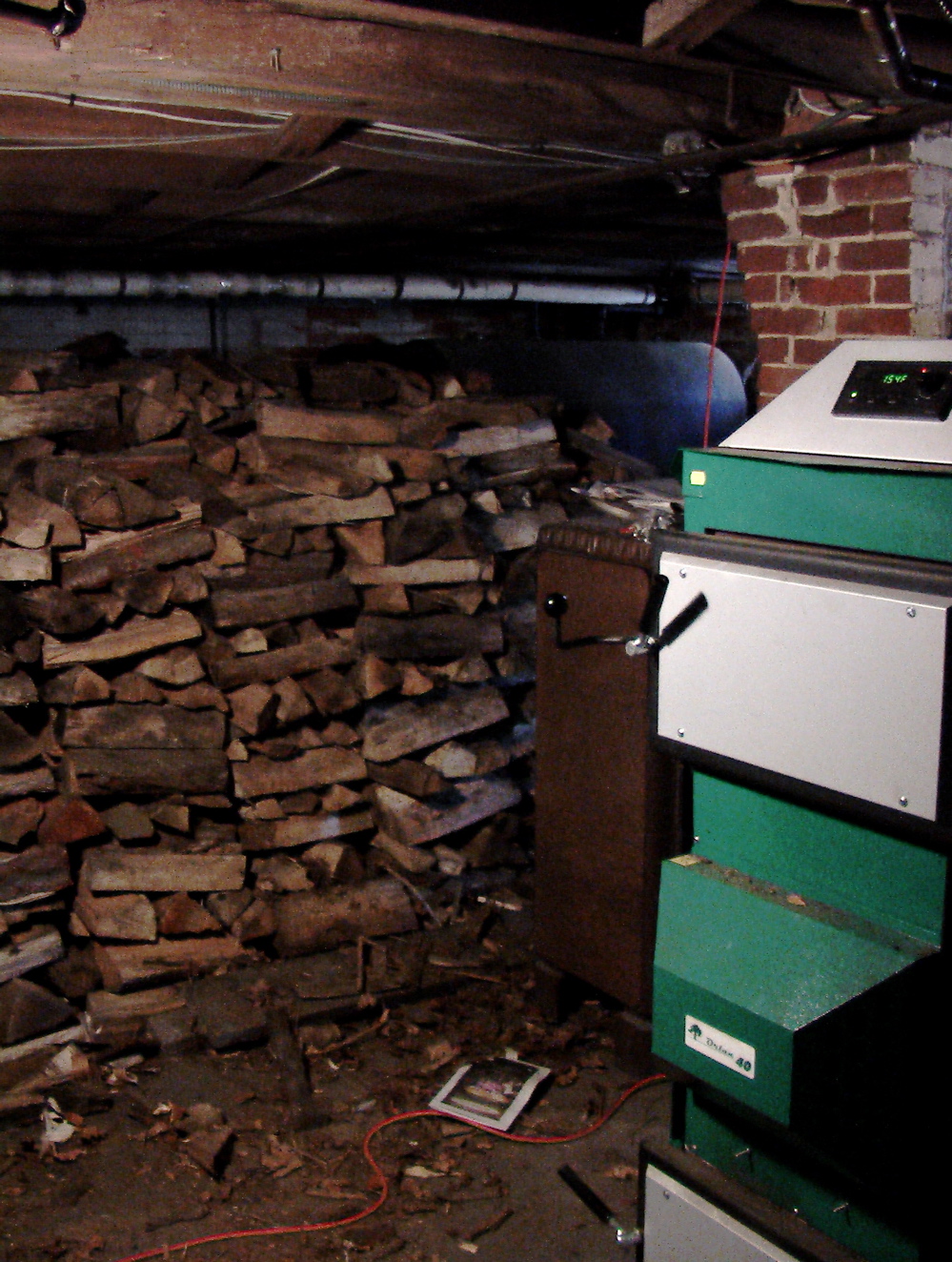
In photo 1 you can see glimpses of all four heating-system eras my 1870 home has known.
The chimney, one of three, originally vented several fireplaces.
The brown box sandwiched between the green-and-white EKO boiler and the woodpile is a coal burner which must have supplemented wood heat at one point.
Then came oil. You can see one of two 250-gallon tanks in the corner behind the woodpile.
And now the EKO boiler, a modern, electronically-controlled device that brings us full circle back to wood.
2: hydronic hookup detail
3: hydronic hookup
Photos 2 and 3 show how the EKO ties into the pre-existing hydronic system. In photo 2 you’re looking at five circuits. Right to left, corresponding to four circulator pumps, are three house zones and a water heater circuit. The leftmost fifth circuit runs through the EKO.
Backing away in photo 3, you can see the EKO on the left, and all five inputs to, and outputs from, the oil burner at bottom right. The EKO is hooked up in series. This costs me some efficiency because, although the oil burner rarely runs, its water jacket soaks up heat. But that may be healthy for it, and though mostly sidelined it’s still a crucial piece of the puzzle.
If the EKO’s water jacket drops below a set temperature — currently 140F — the fossil fuel furnace kicks in automatically. Among other things, that means we can go on vacation without worrying about frozen pipes.
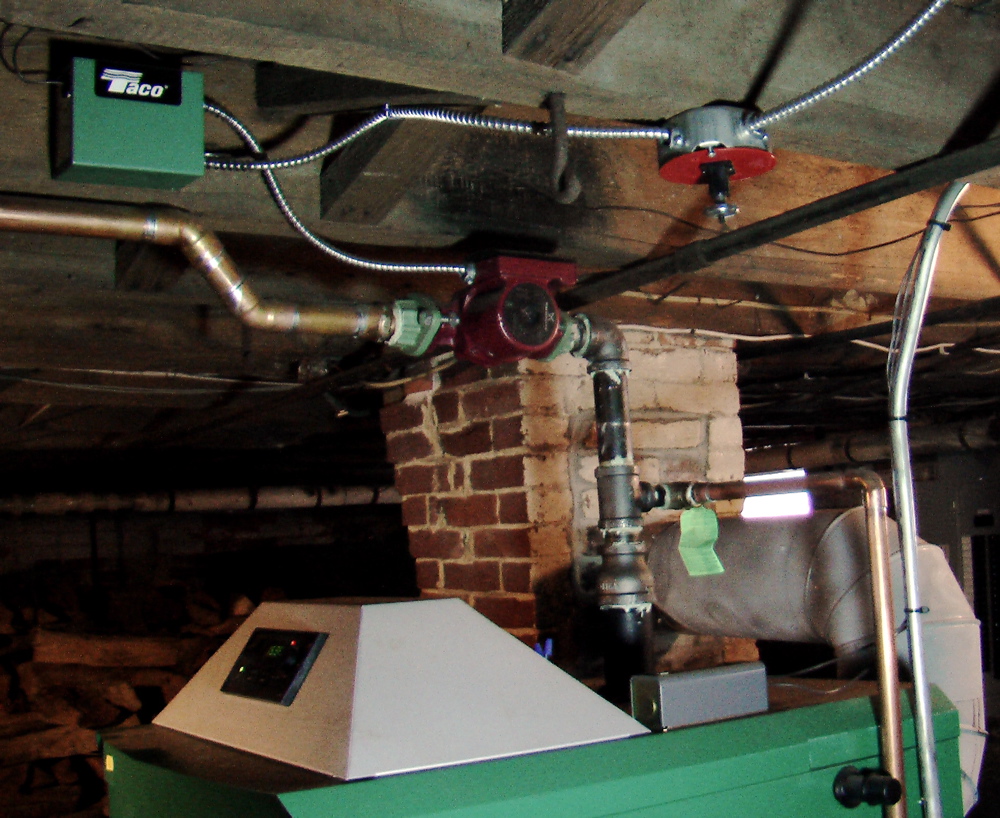
Photo 4 shows parts of the control and safety systems. The green tag is hanging next to a pressure relief valve. If the boiler were to overheat, that valve would open and dump water out onto the floor.
4: relief valve, circulator pump, pump switch
The red circulator pump appears near the center of the photo. The green box at top left activates the circulator when the boiler’s water jacket reaches a threshold currently set at 160F, and then keeps it on until the water temp drops below 140F, at which point the oil burner kicks back on. With the EKO running continuously, the EKO’s circulator can, and does, run for days, idling the oil burner completely.
5: sensor and high-temp cutoff
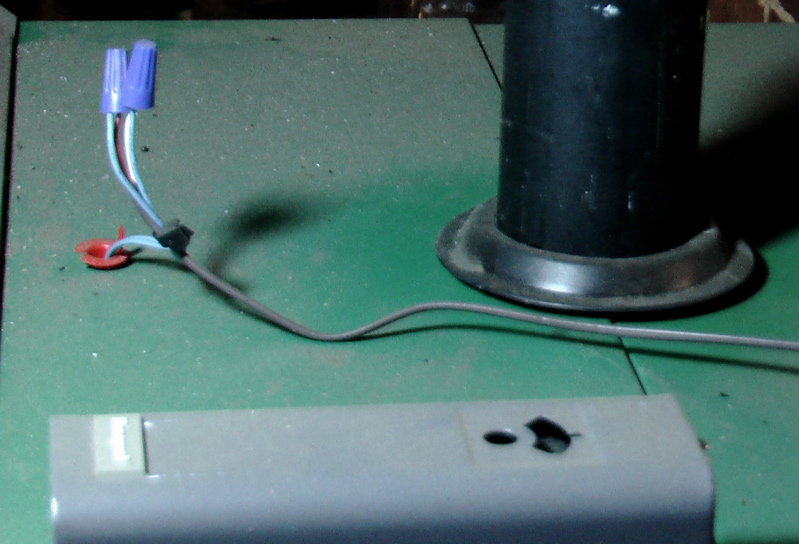
Photo 5 shows a sensor that’s been placed directly on the boiler’s water jacket through a hole drilled into the top cover. Its signal travels to the digital controller shown in photo 7, which actuates the pump switch in photo 4. It also controls a safety cutoff, shown at the bottom of photo 5, that would shut down the boiler (electrically) if its temperature went above 210F.
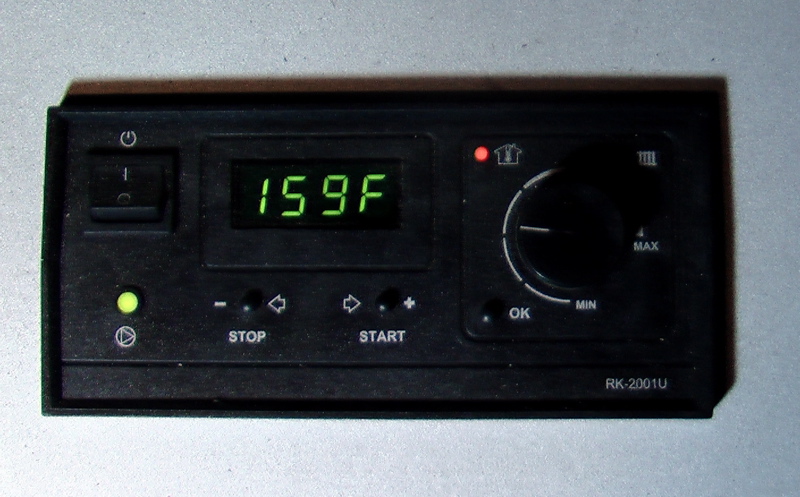
In photo 6 you see the EKO’s control panel. The dial controls the setpoint, which is currently set to 165F. Because the current temp in this photo is below that, the EKO is running in gasification mode. Once it reaches the setpoint, it drops back to idle mode.
6: eko control panel
There are a bunch of menu options here, but so far I’ve only had to fiddle with the setpoint and the fan control. Gasification works by way of a downdraft that sucks wood gas from the firebox in the top chamber down into a bottom chamber where superheated combustion occurs. In idle mode the fan runs at 40% capacity. In gasification mode it can run from 50% to 100%. I’m currently running at 60% unless it’s really cold (10F or below), in which case I bump up to 70%.
This isn’t ideal. I throttle back to keep the boiler from running too hot. Even when idling, there’s a minimum amount of heat produced, and it has to go somewhere. In the ideal scenario, you run flat out in 100% gasification mode and charge up a big thermal battery — e.g., a 500-gallon insulated water tank — then draw on that stored heat. That would be the most efficient, cleanest-burning way to use the EKO.
But the current setup was already a financial and logistical challenge so, like a lot of folks, I’ve punted on the storage tank for now. Meanwhile, we’re thinking about extending a circuit to the attached barn where Luann has her studio, which is currently heated by propane. If we do that we’ll give the EKO more water to heat, it’ll work harder, and it’ll be happier.
7: digital controller
There’s one more safety feature related to overheating. In addition to the relief valve and the high-temp cutoff, the digital controller can activate one of the house zones (the biggest one) and dump excess heat there, even if the zone isn’t calling for it.
The controller appears in photo 7. It senses the EKO’s temperature, switches the EKO’s circulator pump, and controls its high-temp cutoff (see photos 4 and 5). It also controls the fossil fuel furnace, turning it on when the EKO’s water drops below 140F, and off when it rises above 160F.
8: heat-exchange cleaning lever,
damper open/close rod
Photo 8 shows the only two manual controls. The lever at top left cleans the heat exchanger. You just give it a stir whenever you load wood.
The rod with the ball handle opens and shuts the damper. Here it’s pulled out, the damper is closed, and the boiler is running. To load fuel you push in the rod to open the damper, power down the fan, and open the firebox door. When you’re done you shut the door, pull out the rod again to close the damper, and power up the fan.
9: upper firebox
10: lower gasification chamber
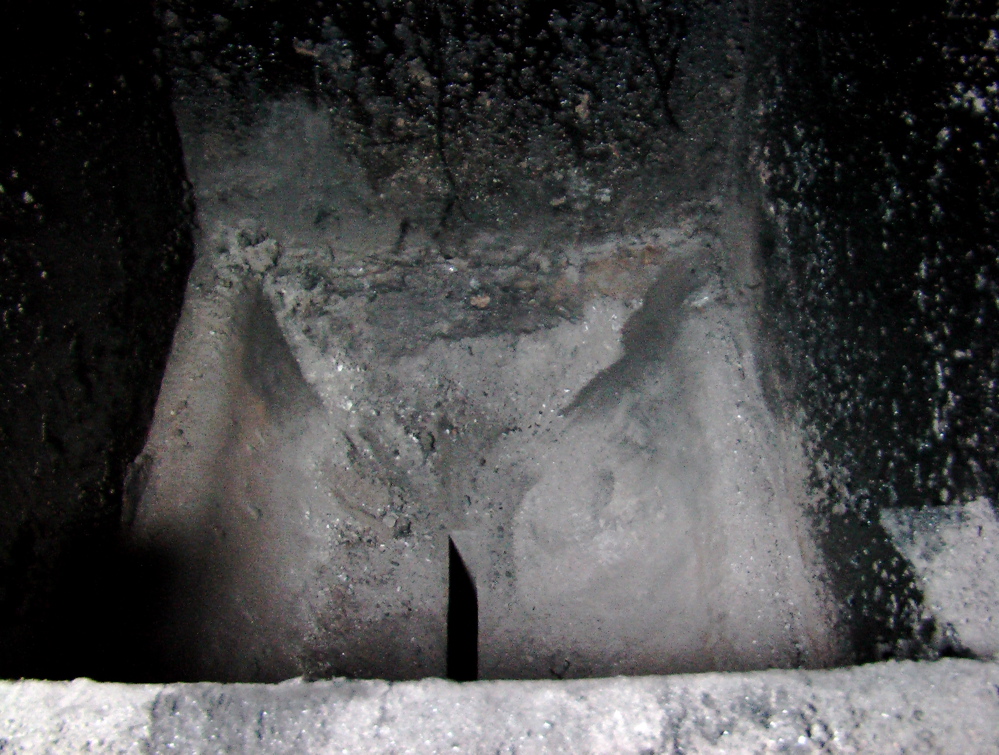
Photo 9 shows the firebox. It’s big, you can load four or even five good-size armloads of split wood. The slot in the bottom connects the top chamber, where the wood burns and emits gas, to the bottom chamber, where gasification occurs.
Photo 10 shows the gasification chamber. You can see the same connecting slot, here from the bottom. Remember, the wood fire burns in the top chamber. Some people like to say that wood gasifiers burn upside down. There isn’t a lot of heat in the top chamber, and the stack temperature runs below 300F. The real heat happens in the bottom chamber.
11: firebox in action
12: gasifier in action
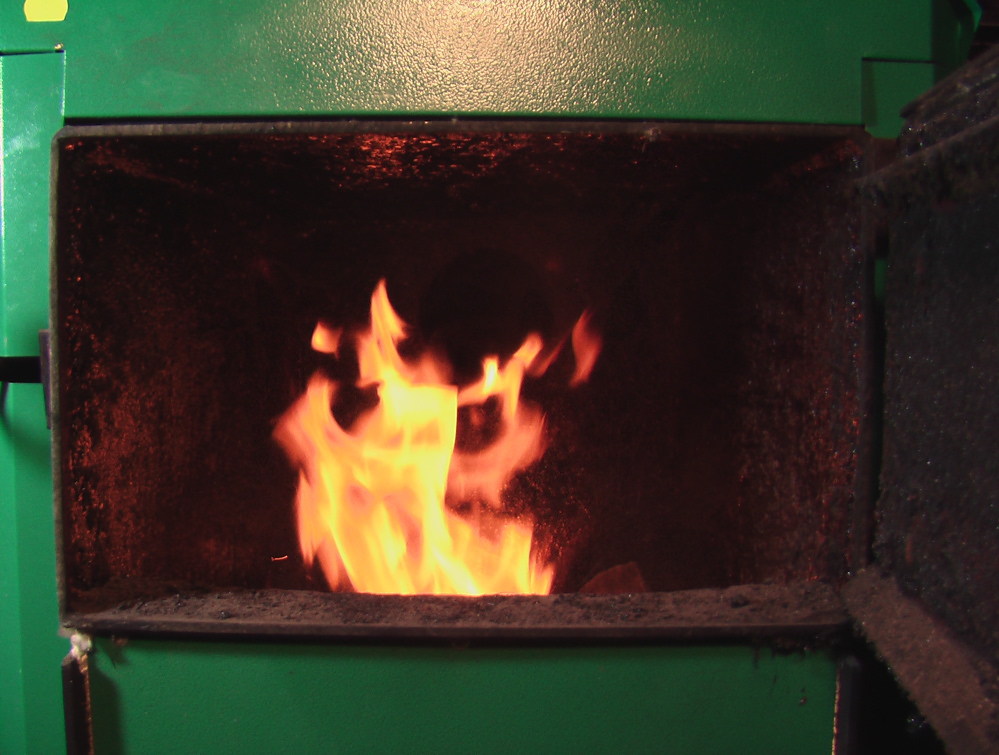
Photos 11 and 12 show the two chambers in action. In photo 11, I’ve lit a wood fire in the cold, freshly-cleaned boiler. You just use newspaper, kindling, and a match, as with any wood fire.
In photo 12, a few minutes later, I’ve loaded more wood into the top chamber, shut the damper, and powered up the fan. What you see, and hear, is like the exhaust from a small rocket engine. At full blast, the temperature approaches 2000F.
A couple of minutes after photo 12, the readouts in photos 6 and 7 hit 160F, the oil burner clicked off, the EKO’s circulator pump clicked on, and my wood-fired central heater was back in action.
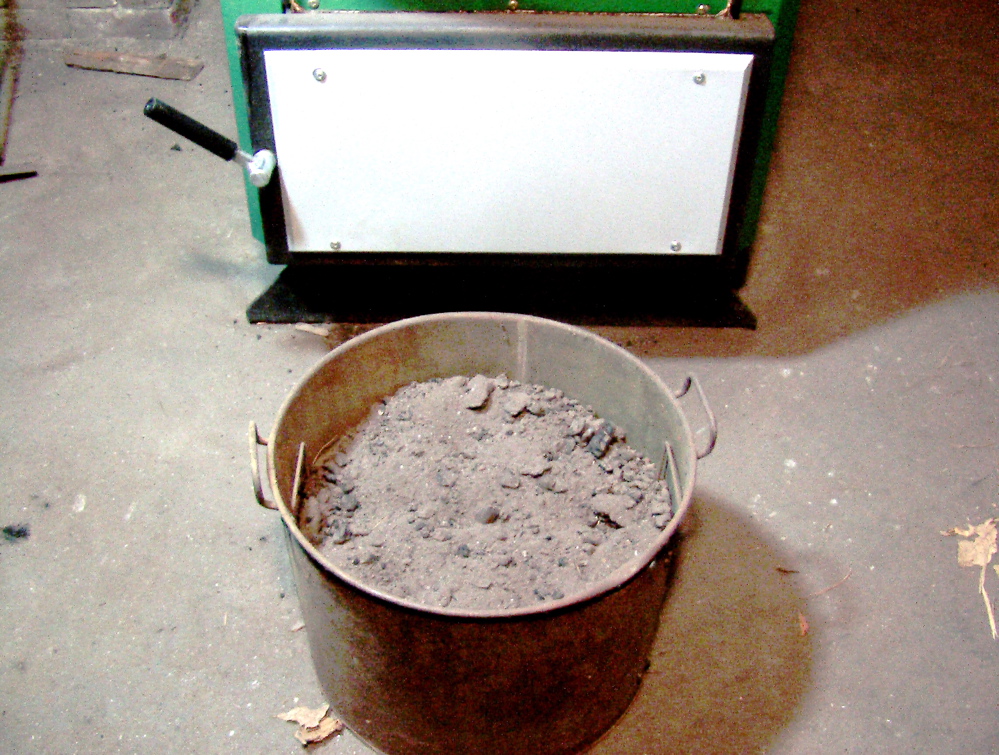
Today’s January 11, and it’s been running since Dec 4. There isn’t much maintenance. I should clean out the ash (and scrape out the creosote) weekly, but I’ve probably only done it three times since I started. Photo 13 shows the entire quantity of ash I’ve removed. As you can see, it isn’t much. The EKO has turned a lot of wood — I’m guessing close to two cords by now — into a very compact volume of powdery ash.
13: five weeks of ash
Two cords? I know. Although it does burn for a long time — a full load can go from eight to twelve hours, depending on the outside temperature — this thing eats wood for breakfast, lunch, and dinner. I bought six cords of semi-seasoned wood, it’s only January 11, I may need to supplement with some seasoned wood come March or April.
Still, I’m OK with that. It’s wonderful to sideline the oil furnace. I’m not saving as much as I would have at $140/barrel oil, but I’m still saving. And I feel like I’ve bought insurance against price volatility that was driving me nuts. Lots of friends pre-bought oil at four-fifty or even five bucks a gallon. That bet paid off every year except this one. I hated living with that craziness.
At May 2008 oil prices, I was looking at a three- or four-year payback for this solution. That doesn’t seem likely now, but I don’t regret the decision. The house is future-proofed with a flexible trio of heating systems. There’s the pellet stove which I still use in spring and fall, the wood boiler for winter, and the oil furnace for backup and for summertime water heat.
There’s been no help from the federal government, by the way. I did some research last fall to find out if my investment in this solution would qualify for a tax credit. According to energystar.gov, there is a tax credit for biomass stoves. But not for 2008. I’d have had to wait another month to earn 2009′s $300 credit. Oh well. EKO-Vimar probably doesn’t provide the manufacturer’s certification statement anyway.
To be honest, I’d rather be living in a smaller, newer house that doesn’t need a furnace. Maybe someday I’ll be able to gut and super-insulate this old house. But meanwhile, like nearly all New Englanders, I’ve got to burn something to survive winter. Most of us still burn oil. But some of us are going back to the future. It’s 1870 again with a twist. We’re burning renewable biomass in clean, efficient, smart appliances, and pumping dollars into the local economy. It’s a start.
January 8, 2009
Posted by Jon Udell under
Uncategorized [4] Comments
In part one of this series I gave an overview of my current project to recreate the elmcity.info calendar aggregator on the Azure platform. In this installment I’ll focus on test-driven development in Azure.
Because I’m doing the core aggregator in C#, I’m using the popular NUnit software to automate the running of my test suite. It’s standard stuff if you’re familiar with the XUnit approach. But if you’re not a programmer, I’ll briefly explain. I think it’s worthwhile because the ideas that inform test-driven programming are an aspect of computational thinking that everyone could generalize from and apply in a variety of useful ways.
A primer on test-driven development
Let’s focus on one small piece of code, a method called AddTrustedEventfulContributor, which implements part of the trusted-feed mechanism I outlined in Databasing trusted feeds with del.icio.us.
As I explained there, when the aggregator’s scan of Eventful events within 15 miles of Keene finds an unknown contributor, as was true recently for Beau Bristow, it creates a del.icio.us record with the tags new, eventful, and contributor. If I decide to trust Beau, I can just change the new tag to trusted by hand. But eventually I’ll want to automate that, so an administrator needn’t remember the tagging convention or worry about making an error.
So AddTrustedEventfulContributor creates (or updates) a del.icio.us bookmark for the URL eventful.com/users/beaubristow/created/events, and ensures that it’s tagged with trusted, eventful, and contributor.
Once the method is written, and seems to work, how can we be sure that it continues to work? The environment is dynamic. The code supporting the method is evolving. And so is the code supporting the del.icio.us and Eventful services it orchestrates. We want to be able to test the method continuously, and verify that it keeps on doing what we expect.
The code to be tested is defined in a file called Delicious.cs, like so:
public static Utils.http_response_struct
AddTrustedEventfulContributor(string contrib)
{
return AddTrustedContributor(contrib, "eventful");
}
private static Utils.http_response_struct
AddTrustedContributor(string contrib, string service)
{
contrib = contrib.Replace(' ', '+');
var bookmark_url = build_bookmark_url(contrib, service);
string tags = "trusted+contributor+" + service;
string args = string.Format("&url={0}&tags={1}&description={2}",
bookmark_url, tags, contrib);
var url = string.Format("{0}/posts/add?{1}", apibase, args);
return do_request_with_url(url);
}
Tests are defined in a parallel file, DeliciousTest.cs, like so:
[TestFixture]
public class DeliciousTest
{
private const string contrib = "xyzas 'dfbyas234";
[Test]
public void t1_addTrustedEventfulContributor()
{
Utils.http_response_struct response =
Delicious.AddTrustedEventfulContributor(contrib);
Assert.AreEqual(HttpStatusCode.OK, response.normal_status);
Assert.That(isSuccessfulDeliciousOperation(response));
Assert.That(Delicious.isTrustedEventfulContributor(contrib));
}
The test calls Delicious.AddTrustedEventfulContributor with the fictitious contributor xyzas ‘dfbyas234, and makes three assertions about the outcome. First, we should get the expected OK status code from del.icio.us. Second, we should get the expected XML response. And third, the expected tags should actually have been applied to the bookmark for xyzas ‘dfbyas234.
Like other XUnit software, NUnit provides a few different ways to run tests. Everyone’s favorite is the GUI testrunner, which displays a tree of test sets (fixtures) and tests, with green and red indicators for pass and fail. The indicators produce a Pavlovian response: You want to see them stay green, and will work obsessively to keep them that way.
The Azure twist
So far this is all standard stuff, but here’s the Azure twist. For a while I was using the GUI testrunner, and then deploying — first to the local Azure development “fabric” and then to the cloud. But the GUI testrunner’s environment isn’t quite the same as Azure. I was reminded of that fact when I added a serialization method to the aggregator.
The original Python-based service uses a binary serialization technique that Pythonistas call pickling. It’s a convenient way to freeze-dry and rehydrate data structures that don’t need to be stored in a queryable or transactional database. You can do the same thing in other programming environments, including Perl, Java, and .NET.
So I implemented .NET-style binary serialization for some intermediate data, and pushed these binary files into the Azure blob store. My NUnit test of this method ran green, but when I deployed into the local fabric it failed. Oh, right. The fabric’s security rules, as I mentioned last time, are different, and stricter than the defaults on your local machine.
Here’s the original serializer, which works outside Azure but not inside:
public void serialize(string container, string file,
List<evt> events)
{
var serializer = new BinaryFormatter();
var ms = new MemoryStream();
serializer.Serialize(ms, events);
var chars = Encoding.UTF8.GetChars(ms.ToArray());
ms.Close();
write_to_azure_blob(container, file, new string(chars));
}
The line shown in red is the culprit. That’s where Azure throws a security exception. Thanks to a clue provided by Brendan Enrick I found this alternate, XML-oriented approach which doesn’t trigger a security exception:
public void serialize(string container, string file,
List<evt> events)
{
var serializer = new XmlSerializer(typeof(List<evt>));
var stringBuilder = new StringBuilder();
var writer = XmlWriter.Create(stringBuilder);
serializer.Serialize(writer, events);
byte[] buffer = Encoding.UTF8.GetBytes(stringBuilder.ToString());
write_to_azure_blob(container, file, buffer);
}
And that’s how these intermediate files are now being written.
At this point I realized that, in order to test things properly, NUnit would have to migrate into the Azure fabric. It’s designed to be embedded in a variety of hosts, but I’ve never tried doing that. Here’s what I learned.
Running NUnit in Azure
The first step, as expected, was to make sure that the NUnit code could even load in Azure’s partial-trust environment. As shipped, it doesn’t. The DLLs won’t load in Azure’s local fabric, or in the cloud. If you’re wondering whether a DLL will or won’t load, Keith Brown’s FindAPTC tool will tell you. It checks DLLs to see if the Allow Partially Trusted Callers attribute is turned on. As I collect components for use in Azure, I find that they often don’t flip that switch.
The solution is to visit files like this one and change them from this:
using System;
using System.Reflection;
[assembly: CLSCompliant(true)]
[assembly: AssemblyDelaySign(false)]
[assembly: AssemblyKeyFile("../../../../nunit.snk")]
[assembly: AssemblyKeyName("")]
To this:
using System;
using System.Reflection;
using System.Security;
[assembly: CLSCompliant(true)]
[assembly: AssemblyDelaySign(false)]
[assembly: AssemblyKeyFile("../../../../nunit.snk")]
[assembly: AssemblyKeyName("")]
[assembly: AllowPartiallyTrustedCallers()]
The needed assemblies turned out to be nunit.core.dll, nunit.core.interfaces.dll, nunit.framework.dll, and nunit.testutilities.dll. After I rebuilt them with the APTC attribute turned on, they loaded.
But I wasn’t home free. I found a couple of things that triggered runtime security exceptions. Here’s one, in this file:
public class DirectorySwapper : IDisposable
{
private string savedDirectoryName;
public DirectorySwapper() : this( null ) { }
public DirectorySwapper( string directoryName )
{
savedDirectoryName = Environment.CurrentDirectory;
if ( directoryName != null && directoryName != string.Empty )
Environment.CurrentDirectory = directoryName;
}
public void Dispose()
{
Environment.CurrentDirectory = savedDirectoryName;
}
}
The lines shown in red fail because the Azure trust policy, a “variation on the standard ASP.NET medium trust policy,” prevents changes to environment variables.
The other offender appears here:
private static Assembly FrameworkAssembly
{
get
{
if (frameworkAssembly == null)
foreach (Assembly assembly in AppDomain.CurrentDomain.GetAssemblies())
if (assembly.GetName().Name == "nunit.framework" ||
assembly.GetName().Name == "NUnitLite")
{
frameworkAssembly = assembly;
break;
}
return frameworkAssembly;
}
}
Because the Azure trust policy places restrictions on reflection, whereby code inspects (and perhaps modifies) itself, these calls to GetName trigger security exceptions. In this case, I believe NUnit is using reflection to segregate its own DLLs from the DLLs under test, in order to keep its internal bookkeeping straight.
My solution to both of these problems was naive and heavy-handed. I just commented out the handful of cases where NUnit tries to change the current directory, or find out if a DLL is one of its own or not. With those changes in place, here’s my Azure-embedded testrunner:
private tatic void doTests()
{
var suites = new Type[] {
typeof(BlobStorageTest),
typeof(DeliciousTest),
typeof(EventCollectorTest),
typeof(EventStoreTest),
typeof(FeedRegistryTest),
typeof(UtilsTest),
};
var fixtures = new List<TestFixture>();
foreach (var suite in suites)
fixtures.Add(TestBuilder.MakeFixture(suite));
string report = string.Format("NUnit Tests at {0}\n\n",
DateTime.Now.ToString());
foreach (var fixture in fixtures)
{
TestSuiteResult results = (TestSuiteResult)fixture.Run(
new NullListener());
foreach (TestResult result in results.Results)
{
report += string.Format("{0}\n",result.Name);
if ( ! result.IsSuccess )
report += string.Format("{0}\n",result.Message);
report += "\n";
}
}
var bs = new BlobStorage();
bs.put_blob("events", "nunit.txt", Encoding.UTF8.GetBytes(report));
}
The aggregator is currently running on a 12-hour cycle. Every time it wakes up, it runs tests and writes this report before it collects events. (It’s a no-news-is-good-news-style report, so if all is well you’ll just see a list of tests.)
Conclusions
It’s nice to know that the aggregator will now test itself continuously, in its production environment. When you park a service in the cloud, you want all the feedback you can get. Constant flows of log data and test reports are essential in order to know that things are working correctly, or to find out why they’re not.
Although these methods are always advisable, I’ll admit I was lazy about them in the current version of the service. It’s running on a Linux box that I can ssh into and poke around on whenever I want. The same would be true if it were running on Amazon EC2. With Azure, as with Google’s App Engine, things are different. The execution environment is more of a black box. You can’t just jump in there and poke around. I miss that.
On the other hand, the black box architecture forces me to rethink some basic assumptions. Should my service expect to be able to modify environment variables? Should it even expect to communicate directly with a file system? We’ve always done things that way, but cloud computing invites us to move to a new level of abstraction. As always, that shift brings challenges along with opportunities.
I’m really of two minds about this. It is frustrating not to be able to use NUnit, unmodified, in Azure. I’m not sure what the effects of my surgery really are, or in what other ways NUnit may yet be incompatible with Azure. A mode of Azure that runs fully trusted code, and even allows EC2-style use of raw virtual machines, would be a wonderful option.
And yet … I haven’t been stymied so far. And part of me wants to embrace constraints in order to gain flexibility at another level of the stack.
From the comments on part one of this series:
“Either give me a machine in the cloud to work on our don’t (anything less is censorship)”
I’d rather have the opportunity to self-censor. And on Amazon EC2 I have that opportunity. That said, when I’ve used EC2 VMs I have been running as root. Why? No good reason, just path of least resistance.
Do you routinely run as root on your personal box, and on hosted boxes? If so, you can do that on EC2, and I suspect you’ll be able to on raw Azure VMs too. But setting the default to something less potent is, well, think about it. Have you ever condemned Microsoft for not being secure by default? How do you square that with condemning Microsoft for being secure by default?
More broadly, the cloud environment is going to challenge a lot of long-held assumptions in what I think will be useful ways. Less so for raw VM hosting a la Amazon, more so for the kinds of “fabrics” of which App Engine and Azure are examples.
That said, although I think it’s useful to challenge assumptions about access to environment variables and file systems, I chafe at the restrictions on reflection. My original plan was to use IronPython for this service, because I believe that the flexibility of dynamic languages will be a key asset in the dynamic environment of the cloud. Currently I’m using IronPython in auxiliary and complementary ways, outside of Azure, as I’ll explain in another installment. Meanwhile I’m finding that C# is becoming more and more dynamic. But reflection is at the core of that dynamism. I’m no expert on this subject, but will be interested to know what folks who are think about the tradeoffs that Azure’s trust policy entails.
January 6, 2009
Posted by Jon Udell under
Uncategorized | Tags:
icalvalid |
[31] Comments
Next up in my series of iCalendar validation examples: The Frost Free Library feed. It fails in three of the four parsers I tried here, and should have failed in all. It begins like so:
BEGIN:VCALENDAR
VERSION:2.0
X-WR-CALNAME:Frost Free Library | January 06, 2009 - February 05, 2009
PRODID:-//strange bird labs//Drupal iCal API//EN
BEGIN:VEVENT
DTSTART;VALUE=DATE-TIME:20090106T203000Z
DTEND;VALUE=DATE-TIME:20090106T203000Z
SUMMARY;ENCODING=QUOTED-PRINTABLE:Library Tea
DESCRIPTION;ENCODING=QUOTED-PRINTABLE:<p>Normal 0 false false false Mic=
rosoftInternetExplorer4</p>=0D=0A<br class=3D"clear" />
URL;VALUE=URI:http://www.frostfree.org/node/505
UID:http://www.frostfree.org/node/505
END:VEVENT
END:VCALENDAR
It’s hard to know exactly what the feed producer thought it was doing here, but the feed should fail because no valid content line can begin with rosoft.... Adding a blank space at the beginning of all such lines will, I think, make the feed at least nominally valid.
But a robust validator would have more to say on the subject. It would notice that this feed is trying to publish HTML content, and would point out that there’s an ALTREP (alternative representation) for this purpose. Setting aside the fact that this feed doesn’t seem to have any actual HTML content, I believe the right way to encode such content would be something like this:
BEGIN:VCALENDAR
VERSION:2.0
X-WR-CALNAME:Frost Free Library | January 06, 2009 - February 05, 2009
PRODID:-//strange bird labs//Drupal iCal API//EN
BEGIN:VEVENT
DTSTART;VALUE=DATE-TIME:20090106T203000Z
DTEND;VALUE=DATE-TIME:20090106T203000Z
SUMMARY;ENCODING=QUOTED-PRINTABLE:Library Tea
DESCRIPTION;ALTREP="CID:xyz":Basic description here.
URL;VALUE=URI:http://www.frostfree.org/node/505
UID:http://www.frostfree.org/node/505
END:VEVENT
END:VCALENDAR
Content-Type:text/html
Content-Id:xyz
<html><body>
<p><b>Enhanced description here</b> Body of
enhanced description.</p>
</body></html>
I don’t know to what extent ALTREPs are actually produced and consumed. My guess is rarely, and that producers might want to lean toward plain text with line folding when that’s sufficient. But that’s just my guess, I’d be interested to hear from folks who know.
January 5, 2009
Posted by Jon Udell under
Uncategorized | Tags:
icalvalid |
[10] Comments
Sam Ruby offers the following advice to those of us who would like to improve the interoperability of iCalendar feeds:
Identifying real issues that prevent real feeds from being consumed by real consumers and describing the issue in terms that makes sense to the producer is what most would call value.
I’ll be documenting issues as I encounter them. Here’s the first: Should feeds use, or not use, blank lines between components? (A component is a chunk of text representing an event, or something else that can show up in an iCalendar file, like a todo item.)
The presence of blank lines is a reason why this feed is one of two I’m tracking that won’t parse in DDay.iCal.
The unmodified feed looks like this:
BEGIN:VEVENT
...stuff...
END:VEVENT
BEGIN:VEVENT
...stuff
END:VEVENT
Part of the “fix” is to make it look like this:
BEGIN:VEVENT
...stuff...
END:VEVENT
BEGIN:VEVENT
...stuff
END:VEVENT
But I’ve put “fix” in air quotes because, well, who’s wrong in this case? The feed producer (in this case, the Keene Chamber of Commerce), or the feed consumer (in this case, DDay.iCal)?
I looked at the spec and didn’t find evidence pointing one way or the other. Neither did this person:
> 1) yes, KOrganizer adds empty lines between VEVENT, VTODO and
> VJOURNAL. I just checked the specification (RFC 2445), and it
> doesn't say anything about blank lines... (neither explicitly
> allowed, nor explicitly not allowed)
This is a perfect example of why the process that Mark Pilgrim and Sam Ruby went through for RSS/Atom feeds will be so valuable for iCalendar feeds. Quite a few details that affect interoperability turn out to depend on assumptions and interpretations that aren’t explicit.
Maybe I’m misreading the spec, and it really does forbid blank lines between components. If so, great, the validator can enforce that rule. But maybe it neither allows nor forbids. In that case, the validator can say so, and suggest a best practice. In this case, my guess is that the best practice would be not to include blank lines.
But I said that remvoing the blank lines is only part of the “fix” — and here’s why. When I remove them, the feed still won’t parse in DDay.iCal, but for a different reason. Now the problem lies here:
BEGIN:VCALENDAR
X-WR-CALNAME:GKCC
BEGIN:VEVENT
...stuff...
In this case, the reason is clearly stated in the spec. A feed is supposed to include VERSION and PRODID properties like so:
BEGIN:VCALENDAR
VERSION:2.0
PRODID:-//hacksw/handcal//NONSGML v1.0//EN
BEGIN:VEVENT
If I inject those into the Chamber of Commerce feed, and remove blank lines, it parses in DDay.iCal.
Note that the unmodified feed is reported to be valid by this iCal4J-based validator. A more robust validator, in the style of the Pilgrim/Ruby RSS/Atom validator, would fail the feed, and would cite the relevant part of the spec in its explanation of the failure.
The spec says, by the way, that both VERSION and PRODID are required elements. When I saw that DDay.iCal was rejecting the Chamber of Commerce feed, which contains neither, I figured that was why. And sure enough, it accepts this:
BEGIN:VCALENDAR
VERSION:2.0
PRODID:Keene Chamber of Commerce
X-WR-CALNAME:GKCC
BEGIN:VEVENT
But it also accepts this:
BEGIN:VCALENDAR
VERSION:2.0
X-WR-CALNAME:GKCC
BEGIN:VEVENT
And this:
BEGIN:VCALENDAR
PRODID:Keene Chamber of Commerce
X-WR-CALNAME:GKCC
BEGIN:VEVENT
But not this:
BEGIN:VCALENDAR
PRODID:Keene Chamber of Commerce
BEGIN:VEVENT
Eventually I twigged to the fact that it’s evidently just looking for two (or more) non-empty lines between the BEGINs. For example, this parses:
BEGIN:VCALENDAR
FOO:BAR
BAZ:FOO
BEGIN:VEVENT
In practice this isn’t a big deal. None of the metadata matters to me, for my purposes, so my aggregator can just elide it before sending a feed to the parser. But the metadata might matter for someone, for some purpose. A proper validator would help ensure that it will be available to those people, for those purposes, by enabling feed producers and feed consumers to more easily produce and consume valid feeds.
For what it’s worth, I’m going to track this category of issue using the tag icalvalid, and I invite other interested parties to do the same. As in the case of the grl2020 tag, I know the tag can appear in a variety of places including del.icio.us, Technorati, WordPress, and nowadays of course Twitter. So I’ll create a metafeed that tracks icalvalid in all of those places.
Update: OK, here’s the icalvalid metafeed, based on this Yahoo Pipe.
January 5, 2009
Posted by Jon Udell under
Uncategorized [4] Comments
On this week’s Interviews with Innovators show I spoke with Jeff Jonas whose work (and narration of that work on his blog) first captured my interest in 2007.
If you follow Jeff you’ll know what he means when he uses phrases like perpetual analytics, non-obvious relationship awareness, semantic reconciliation, sequence neutrality, and anonymous resolution. If not, and if you’re interested in how we can connect the dots across siloes of data, I recommend that you peruse his blog first and then listen to this interview, which clarifies a couple of points I’d been wondering about.
One of Jeff’s tenets is that new information has be able to answer old questions, and answer them in near-realtime. On the face of it that seems impossible. How can you compare a newly-ingested fact with every existing fact in a database, and run every imaginable query?
Well of course you can’t, and don’t, visit every record in the database. You consult an index, and the interesting question becomes: What kind of index? In Jeff’s world, it’s an index based on keys that represent entities (people, places, organizations) and “features” (locations, relationships). And these entities are fuzzily defined. I think of them as clouds of associations. So for example the key for Jon Udell would point to items where Jon is misspelled as John. Most systems abhor this kind of variation, but Jeff embraces it, and I find that fascinating.
Another intriguing idea was reported by Phil Windley in his write-up on Jeff’s ETech talk:
Jeff treats query as data. When a query is made against the context, and gets no response, it’s stored in the database. Later if data shows up that matches the query, you get a match. Treating queries like data makes it so you don’t have to ask every question every day.
Here again, I wondered how you avoid running every query against every new fact. What does it mean for data to “match” a query? Part of the answer, as I understand it, is that both queries and data are indexed semantically, using keys that encompass clouds of associations.
Another part of the answer emerged in this interview. You have to be really sure about those associations. If you put a John Udell record into the Jon Udell bucket, you had better be certain that this is a legitimate misspelling in an item that refers to a particular instance of Jon Udell (i.e., me, not this guy), rather than a legitimate reference to one of the John Udells.
Now that I know about this constraint, the whole thing makes more sense.
January 2, 2009
Posted by Jon Udell under
Uncategorized [11] Comments
If you were tuned into the blogosphere back in 2001, you’ll recall lots of chatter about RSS feed validation. RSS came in multiple flavors. Anyone could whip up a feed purporting to be in one or another of those formats, and many of us did. There were all kinds of questions about how and why feeds did or didn’t conform to the various specifications.
Nowadays we have even more flavors. There’s RSS 2.0. And there’s Atom, which isn’t a member of the RSS family at all, it’s a different species of feed format. And yet you rarely hear about problems with feeds that can’t be read and processed by feedreaders.
I think there are two reasons why RSS/Atom-style feeds work pretty well nowdays. First, there’s the Feed Validator. Mark Pilgrim and Sam Ruby put a huge amount of effort into this excellent tool. Why? Here is their explanation:
Despite its relatively simple nature, RSS is poorly implemented by many tools. This validator is an attempt to codify the specification (literally, to translate it into code) to make it easier to know when you’re producing RSS correctly, and to help you fix it when you’re not.
The second reason is that RSS/Atom-style syndication has been happening in a lot of places for a long time now. A lot of people have used, and helped to refine, the tools and techniques.
Now I’m exploring the parallel world of calendar syndication, using ICS feeds instead of RSS/Atom feeds. And it feels like 2001 all over again. There are ICS feeds out there, but nowhere near as many as RSS/Atom feeds. And my hunch is that even when ICS feeds are published, they’re often unused, so there isn’t enough feedback to flush out problems. Finally, the ICS equivalent of the RSS/Atom Feed Validator — a service called iCalendar Validator, based on a Java library called iCal4j — isn’t anywhere near as comprehensive and informative as the RSS/Atom Validator.
Here’s a chart that lists the iCalendar feeds currently being collected by the elmcity.info calendar aggregator.
As you can see, the results are all over the map. Some purportedly valid feeds won’t load using one iCalendar library, some won’t load using another. Some purportedly invalid feeds do load.
I expect things will get worse before they get better. There are only a handful of different ICS producers represented here, but the two labeled homegrown were created directly or indirectly in response to my project. If we recapitulate the RSS/Atom experience with ICS, and lots more ad-hoc ICS feeds arrive on the scene, charts like this will go even redder.
To make them go green, we’ll need a more robust ICS validator.