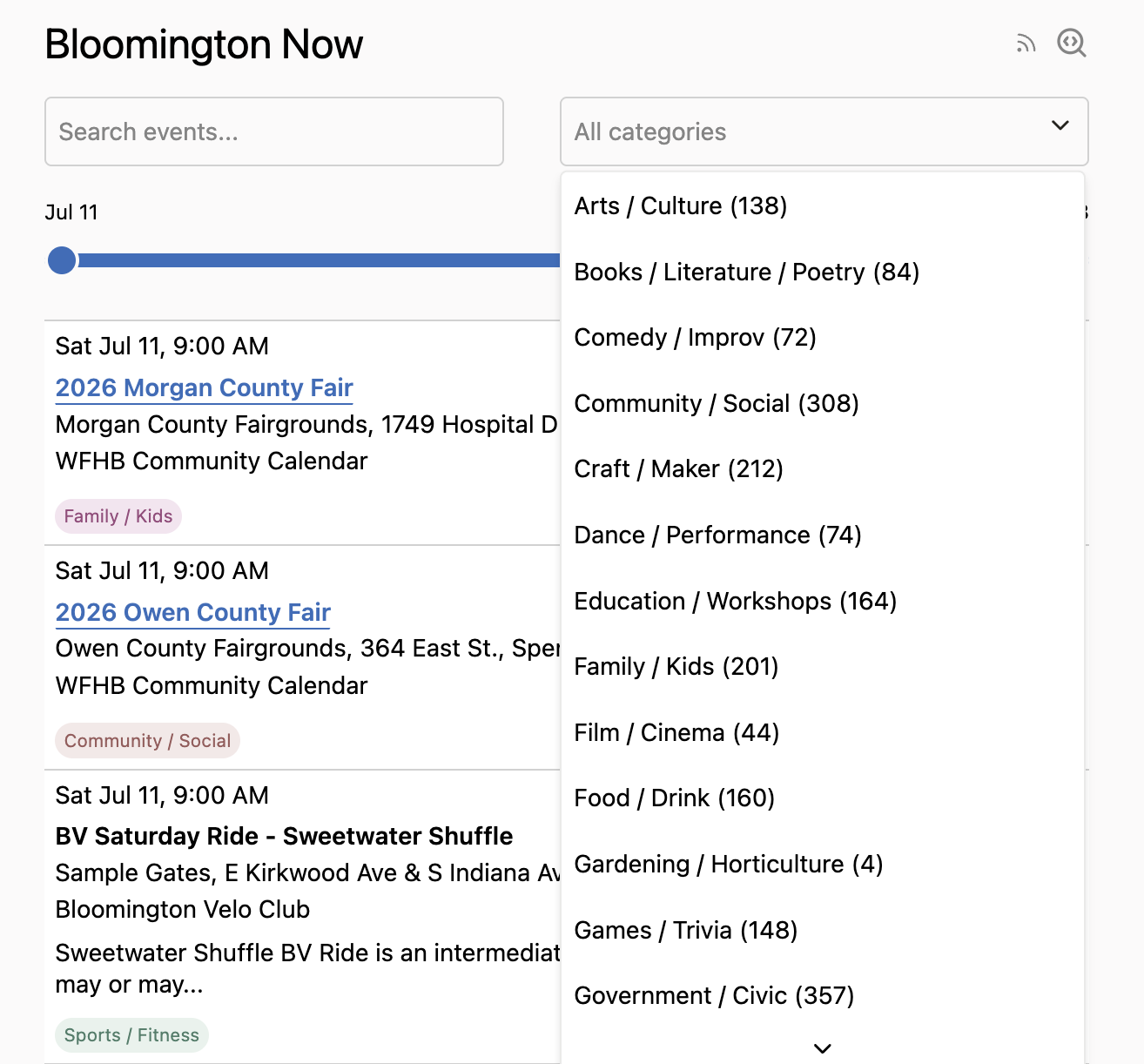
In this snapshot of the Bloomington calendar you can see that events are neatly categorized.

This was an intractable problem a dozen years ago. Should the county fair land in community / social or family/kids? It’s not a critical choice, and as a user of the calendar you’d accept either. For the calendar’s curator, though, hundreds or thousands of such choices add up to an unsustainable cognitive burden.
In the Before Time you could imagine a function that takes in event titles and descriptions and uses regexes and word lists to map an event to a category. But that was unsustainable too. What we always needed, and now can have, is a function that requires no procedural code to effect that mapping. My LLM-assisted community calendar reboot calls Anthropic’s Haiku to categorize events.
It costs less than a penny a day to relieve the curator of this cognitive burden. With an agent in the loop, of course, curators must have final say. So I built an override mechanism that enables a switch from, say, family/kids to community/social. It also records those overrides and feeds them into future classifications. That seemed important but to my knowledge it has rarely if ever been used, Haiku’s mappings do the job well enough.
Tagging individual events is a poor use of a curator’s time and effort. You’d rather just encourage people and organizations to write good titles and descriptions for their events. Procedural code can’t enable that but a low-powered LLM can.

I would have thought the correct solution was to re-examine the categories and discuss their use. The ones you name can easily be grouped together.
The issue is volume of events, and the time and effort required to make decisions about each.